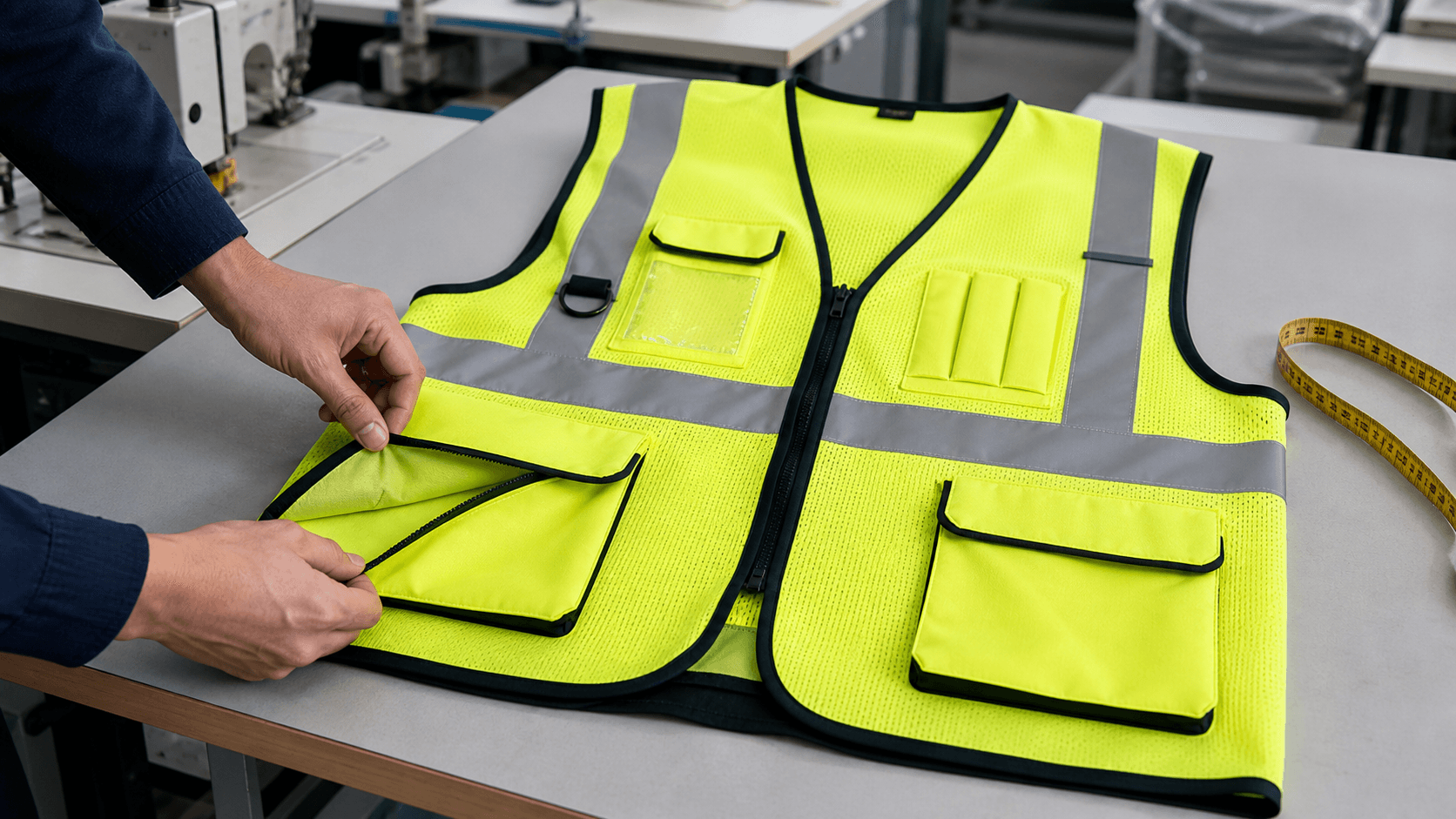
A safety vest with pockets should be specified around the tools a worker actually carries, not by pocket count alone. For bulk buyers, the right design balances access, retention, load, comfort and high-visibility compliance. A practical specification identifies each pocket’s purpose, dimensions, closure, reinforcement and position, then checks the finished vest—not only the base fabric or reflective tape—against the applicable requirement.
This guide is for PPE distributors, construction companies, utility teams, survey crews and private-label buyers comparing multi-pocket safety vests. It explains which pocket layouts suit different jobs, where designs commonly fail and what information a factory needs before sampling.
What Is a Safety Vest with Pockets?
A safety vest with pockets is a high-visibility or enhanced-visibility garment that adds storage and attachment points for work items such as identification cards, pens, phones, radios, notebooks and small tools. The phrase describes a functional feature; it does not prove a particular ANSI/ISEA 107, CSA Z96 or EN ISO 20471 classification.
That distinction matters in procurement. OSHA requires warning garments in specified U.S. construction situations, including employees exposed to public vehicular traffic near excavations, but the correct garment specification still depends on the hazard, controlling rule and work environment. ANSI/ISEA 107 addresses the finished garment’s visible materials and design. Pockets therefore need to be evaluated as part of the complete vest.
Which Pocket Types Are Most Useful?
There is no universal “best” layout. Start with a carry list for each role, then choose the smallest number of pockets that supports the work without creating unnecessary bulk.
Lower cargo pockets
Large lower pockets can hold gloves, a compact notebook, marking supplies or lightweight tools. Buyers should specify finished dimensions, whether the pocket has bellows, the flap depth and the closure. A flat patch pocket is lower profile; a gusseted cargo pocket offers more capacity but projects farther from the garment and places more stress on the attachment seam.
Chest and pen pockets
Chest pockets keep frequently used small items within reach. Narrow pen channels should be sampled with the actual marker or pencil diameter. If a phone is expected, define the device dimensions and whether it will be used with a protective case. “Phone pocket” without dimensions is not a production specification.
Clear ID windows
A clear ID window is useful for security, logistics, site visitors and access-controlled facilities. The RFQ should state card size, portrait or landscape orientation, loading direction and whether the insert needs weather protection. The window should remain readable without interfering with the zipper, reflective bands or radio equipment.
Zippered and internal pockets
Zippers improve retention for keys or other small valuables. Internal pockets keep the exterior cleaner and can reduce snagging, but they must remain accessible over work clothing. Confirm zipper length, puller style, opening direction and whether gloves will be worn.
Radio loops and microphone tabs
These are attachment points rather than pockets, but they belong in the same equipment-layout review. A loop must be positioned for the intended radio or microphone and reinforced for its expected load. The cable route should not cross the front closure, neck edge or a breakaway connection.

How Should Buyers Match Pocket Layout to the Job?
| User group | Typical carry needs | Useful configuration | Approval risk |
|---|---|---|---|
| Construction crew | Phone, marker, gloves, small notes | Two lower pockets, chest pocket, pen channels | Overloading mesh or blocking access with a harness |
| Survey crew | Field book, markers, radio, small instruments | Reinforced cargo pockets, chest compartments, radio loop | Poor weight balance or pockets too small for the field book |
| Security and events | ID, radio, phone, access list | ID window, radio loop, zippered chest pocket | Equipment obscuring identification or reflective material |
| Warehouse and logistics | Scanner, pen, badge, phone | ID window, pen slots, secure device pocket | Device dimensions not confirmed before production |
The table is a starting point, not a safety assessment. A purchasing team should confirm actual equipment, work posture, outer layers and any fall-arrest harness or tool belt used with the vest.
Can Pockets Affect ANSI/ISEA 107 Compliance?
Yes. ANSI/ISEA 107-2020 specifies minimum visible areas, material performance and placement for high-visibility safety apparel. Its optional-feature criteria address pockets as part of garment design. Pockets made from matching or contrasting compliant high-visibility material must not create horizontal gaps greater than 50 mm (2 in.) in retroreflective or combined-performance material.
This is why adding pockets to an existing vest is not merely a sewing change. Pocket panels, flaps, zippers, binding, ID windows, logos and radio tabs can change visible background area, interrupt reflective bands or alter the front-to-back balance of a design. A supplier’s certificate for reflective tape alone does not demonstrate that a newly customized finished garment meets the intended classification.
For a compliant project, state the exact standard edition, garment type and performance class in the RFQ. Ask how the finished design, size range and customization will be verified. If formal certification is not required, say so explicitly and still define the visibility outcome you expect.
Mesh or Solid Fabric: Which Supports Pockets Better?
Mesh improves airflow and reduces garment weight, making it useful in warm conditions. However, an open or lightweight mesh may need reinforcement where pockets, loops and zippers are attached. Heavy objects can distort the panel or make the vest hang unevenly if the structure is not designed for the load.
Solid tricot or woven fabric generally gives pocket seams a more continuous base and can support structured compartments more easily. The tradeoff may be lower airflow or greater weight. Hybrid construction is also possible—for example, mesh body panels with solid-fabric pocket zones—but the finished configuration should be reviewed for comfort, durability and any applicable visible-area requirements.
Do not select material by the word “mesh” alone. Ask for composition, fabric weight, knit or weave construction, color performance, tensile or tear evidence where relevant, and a loaded-wear sample for demanding pocket configurations.
What Construction Details Improve Pocket Durability?
- Reinforced stress points: pocket corners, loop ends and zipper stops may need bar tacks or another suitable reinforcement.
- Appropriate seam allowance: the pocket should have enough material for consistent stitching without weakening the edge.
- Compatible components: zipper tape, hook-and-loop, binding and pocket fabric should suit the garment’s use and care method.
- Load distribution: large pockets should not concentrate weight on one lightweight mesh panel.
- Clean drainage and access: outdoor designs may need drainage or weather-resistant closures, while gloved users need larger openings and pullers.
Durability should be confirmed on a pre-production sample using the intended contents. YOLITE recommends that buyers provide representative tools or their dimensions so the factory can check capacity, access and garment balance before bulk production.
How Do Logo Printing and Pockets Interact?
Logo placement should be planned at the same time as the pocket map. A back logo may appear simple, but front identification, department text or employee names must compete with chest pockets, ID windows and reflective bands for space.
Do not place a print across a pocket opening, zipper or high-stress fold unless the method has been designed for that construction. Printing on mesh can also look different from printing on solid fabric. The buyer should approve artwork size, location, color, method and finished appearance on the actual vest material.
For high-visibility apparel, customization must also preserve the required visible material and reflective configuration. See YOLITE’s screen printing vs. digital printing guide for a broader comparison of workwear decoration methods.
Seven Checks Before Approving a Bulk Order
- Define the work and hazard: identify market, environment, visibility requirement and other PPE worn with the vest.
- List every carried item: provide dimensions and approximate loaded weight where it affects construction.
- Approve a pocket map: use front and inside drawings with dimensions, openings, closures and attachment points.
- Confirm material and reinforcement: check whether mesh areas require solid backing or bar-tack reinforcement.
- Review compliance after customization: consider pockets, ID panels and logos on the finished garment across the size range.
- Wear-test the sample: load the intended items, bend, reach, sit and test access while wearing normal work layers.
- Lock the approved specification: record materials, measurements, tolerances, artwork, packaging and inspection criteria before mass production.
For a structured supplier enquiry, use YOLITE’s hi-vis workwear RFQ guide. It helps procurement teams compare quotations on the same specification instead of comparing unit price alone.
What Should Be Included in the RFQ?
Send the supplier the target country, end use, quantity, size range, fabric preference, color, closure, reflective material layout, pocket drawing, actual equipment dimensions, logo artwork, required documents, packaging and delivery destination. For private-label work, add label language, barcode or carton-mark requirements and the approval sequence for samples.
A useful RFQ does not say only “six-pocket Class 2 vest.” It identifies what those six pockets must do and asks the factory to confirm whether the complete customized garment can support the requested classification.
Frequently Asked Questions
How many pockets should a safety vest have?
Use as many as the job requires and no more. Pocket count is less important than dimensions, position, closure, reinforcement and whether the loaded vest remains comfortable and compatible with other PPE.
Are more pockets always better?
No. Extra pockets add seams, material, bulk and potential snag points. They can also complicate reflective-tape placement and logo positioning. A role-specific layout is usually better than the highest possible count.
Can a mesh safety vest carry tools?
It can carry appropriate lightweight items when the pocket zones and attachment seams are designed for them. Heavier contents may require reinforced panels, stronger construction or a different garment system.
Can pockets cover reflective tape?
A customized design should not casually cover or interrupt reflective material. For projects claiming ANSI/ISEA 107 compliance, the finished design must preserve the applicable material area and configuration requirements, including limits on horizontal gaps.
Can YOLITE customize pocket size and layout?
YOLITE can evaluate custom pocket layouts for OEM and wholesale projects. Send the intended contents, drawings, quantity, target standard and branding requirements so the team can confirm a suitable sample-development route.
Request a Multi-Pocket Safety Vest Quote
Tell YOLITE who will wear the vest, what they carry and where the garment will be used. We can review fabric, pocket structure, reflective layout, branding, sizing, packaging and sampling requirements for your B2B project. You can also explore the reflective safety vest range before sending your specification.
Sources and Scope
1. Occupational Safety and Health Administration, “29 CFR 1926.651 — Specific Excavation Requirements,” section 1926.651(d), accessed August 31, 2026. https://www.osha.gov/laws-regs/regulations/standardnumber/1926/1926.651
2. Occupational Safety and Health Administration, “Whether use of high-visibility warning garments by construction workers in highway work zones is required,” August 5, 2009. https://www.osha.gov/laws-regs/standardinterpretations/2009-08-05
3. American National Standards Institute, “ANSI/ISEA 107-2020: High-Visibility Safety Apparel,” November 2, 2020. https://blog.ansi.org/ansi/ansi-isea-107-2020-high-visibility-apparel/
4. 3M, “ANSI/ISEA 107-2020 Made Easier: A Quick Reference to the High-Visibility Safety Apparel Standard.” https://multimedia.3m.com/mws/media/638577O/ansi-107-2020-made-easier.pdf
This article is a procurement guide, not a substitute for the complete standard, a workplace hazard assessment or advice from the authority responsible for your project. Requirements can vary by jurisdiction, contract, garment type, performance class and standard edition.

AUTHOR
Jack Lee
Founder · Yolite Industrial Co., Ltd.
Reflective-products specialist since 2003, focused on reflective materials, high-visibility apparel, OEM customization, and practical product development for international buyers.
View LinkedIn Profile