A useful hi-vis workwear RFQ does more than ask for a unit price. It tells suppliers exactly where the garment will be used, which market it is intended for, what construction and documentation you expect, and how quotations will be compared. That detail makes quotes easier to evaluate and reduces expensive revisions after sampling.
Download the Free Hi-Vis Workwear RFQ Files
Use these editable resources before contacting suppliers:
The files are planning tools, not certificates or legal advice. Confirm the applicable requirements with a competent safety or compliance professional in the destination market.
What a Hi-Vis Workwear RFQ Should Achieve
An RFQ—request for quotation—should make competing offers comparable. If one supplier quotes a mesh vest, another quotes a waterproof jacket and a third prices an unverified catalogue style, the lowest number tells you very little.
A strong RFQ creates a shared baseline. Suppliers should respond against the same intended use, garment type, performance requirement, size range, customization, packaging and documentary evidence. You can then separate genuine commercial differences from missing scope.
1. Describe the Worksite Before Describing the Garment
Start with the risk and task, not a catalogue reference. Tell suppliers whether wearers work around road traffic, forklifts, loading bays, rail equipment or low-light industrial machinery. Record viewing distance, vehicle speed, daylight and night work, rain, heat, contamination and typical wearing time.
Include the destination country and industry. A product intended for an EU construction contractor may have different conformity and documentation expectations from promotional clothing or workwear sold elsewhere. Do not ask a factory to guess the applicable market.
| RFQ input | Useful detail | Why it matters |
|---|---|---|
| Work environment | Roadside, warehouse, port, airport or factory | Establishes the real visibility context |
| Weather | Dry, rain, wind, cold or heat | Affects fabric, layering and closure design |
| Exposure | Full shift or short task | Influences comfort and durability priorities |
| Target market | Country and industry | Guides standards and documentation checks |
| Wearer tasks | Driving, lifting, bending or climbing | Helps define fit and garment design |
2. State Standards Without Turning the RFQ Into a Certificate
Name the standard and edition your project requires, but require evidence for the exact finished garment. For European PPE, Regulation (EU) 2016/425 establishes requirements for the design and manufacture of personal protective equipment placed on the EU market. EN ISO 20471 is commonly used for professional high-visibility clothing, while other risks—such as rain or limited flame spread—may involve separate standards.
Do not treat a reflective-tape data sheet as proof that the complete jacket complies. Ask for the certificate or report reference, product identification, issuing body where applicable, classification, standard edition and a clear link between the document and the offered style.
Use wording such as: “Supplier shall identify the applicable standard and edition for the finished garment and provide matching conformity documents for review before order approval.”
3. Convert the Product Idea Into a Measurable Specification
Replace adjectives such as “premium,” “strong” and “very waterproof” with details that can be checked. State the garment type, base fabric, approximate weight if relevant, color, reflective-material layout, closure, pockets, hood, cuffs, lining and intended layering.
For a jacket, your specification might cover:
- fluorescent color and contrast panels;
- reflective tape width, position and continuity;
- front zip and storm-flap construction;
- detachable, fixed or concealed hood;
- cuff and hem adjustment;
- pocket count, position and closure;
- lining or insulation;
- seam construction and weather-protection requirement; and
- care label and expected wash method.
If a detail is still open, identify it as a supplier proposal rather than leaving it ambiguous. That gives the factory permission to recommend an option without silently changing the scope.
4. Request a Size Table, Not Only an S–3XL Label
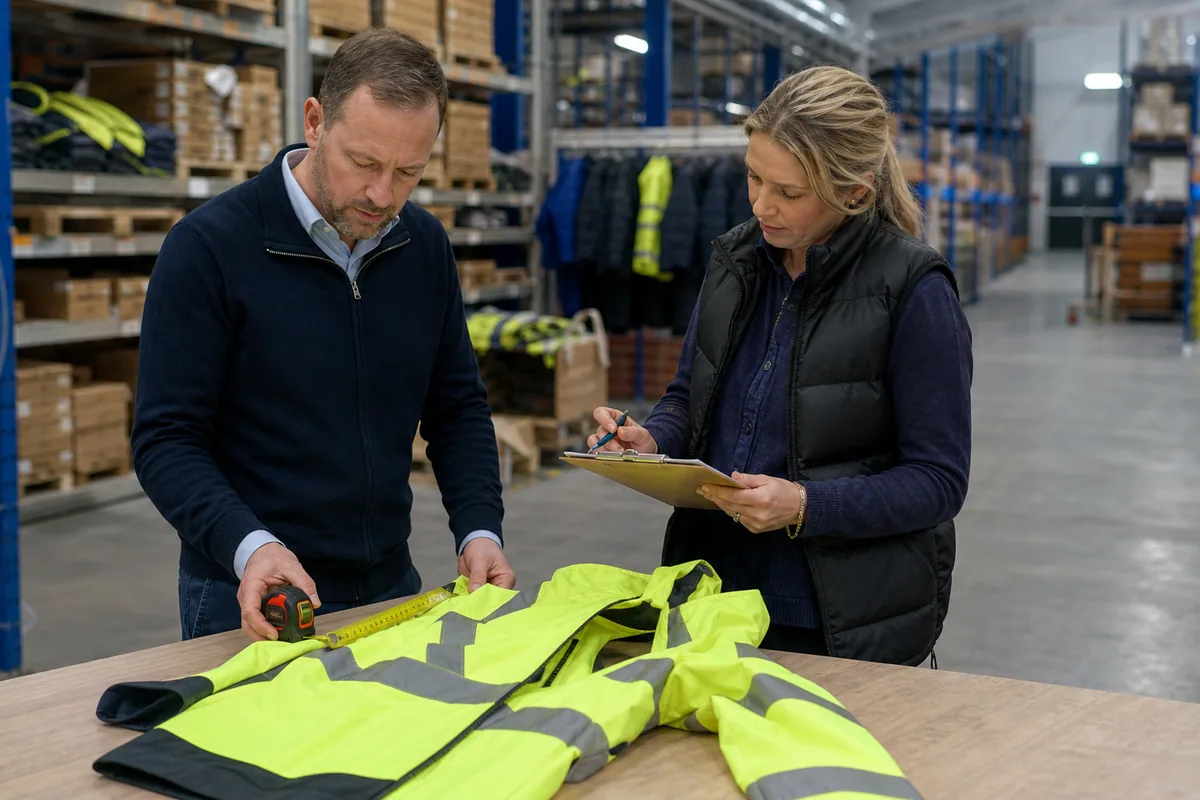
Letter sizes are not consistent between suppliers. Ask for finished garment measurements, measurement points, tolerances and the base size used for grading. Specify whether the jacket must fit over other clothing and whether men’s, women’s or unisex patterns are required.
Before bulk production, review a size set or at least the critical sizes for your wearer population. Check reach, bending, pocket access, sleeve length and whether movement exposes or folds important high-visibility areas.
5. Control Logo Placement and Packaging Early
Branding can change both appearance and garment performance. Give suppliers the artwork format, colors, dimensions, position and application method. Ask them to flag any location that may cover reflective material or required fluorescent areas.
Packaging belongs in the RFQ too. State whether you need individual bags, barcode labels, carton marks, size ratios, multilingual instructions or retailer-specific packaging. Small assumptions in packaging often become late charges or shipment delays.
6. Define the Sample and Approval Gates
A quotation is not the final product. Build approval stages into the RFQ so both parties understand when commercial and technical decisions become fixed.
| Stage | What to review | Approval evidence |
|---|---|---|
| Material proposal | Fabric, reflective material, trims and colors | Swatches and supplier data |
| Development sample | Design, construction, branding and fit | Written comments with photos |
| Size set | Measurements and grading | Signed measurement table |
| Pre-production sample | Final materials, labels and packaging | Approved reference sample |
| Bulk inspection | Workmanship, quantity and packing | Inspection record |
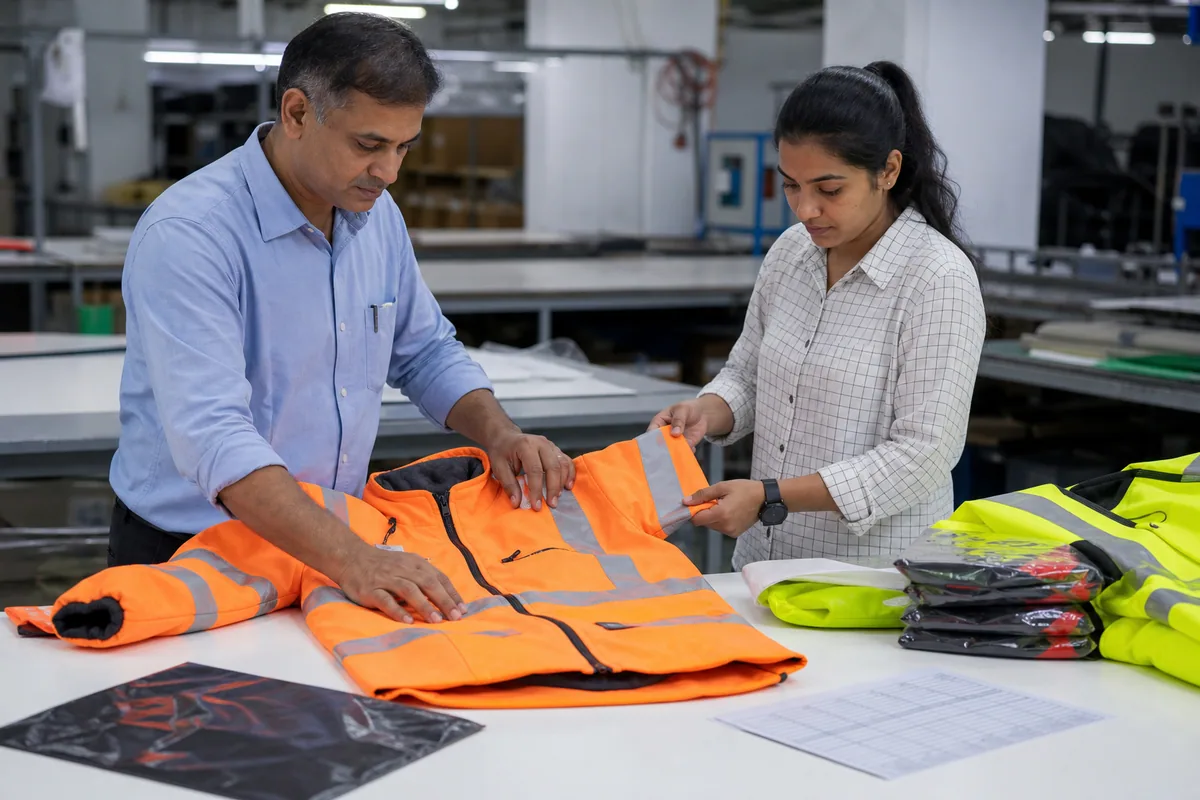
State who pays for samples and freight, how many revision rounds are included, and whether sample charges are refundable after an order. Ask for realistic sample and approval lead times rather than only a production estimate.
7. Ask for a Complete Commercial Breakdown
Unit price is meaningful only when its basis is clear. Request currency, Incoterm, named port or place, MOQ, quantity breaks, tooling or artwork charges, sample costs, packaging assumptions, payment terms, production lead time and quotation validity.
Keep optional items separate. For example, show the base jacket price, detachable hood, extra pocket, custom carton and third-party inspection as individual lines. This makes cost engineering possible without restarting the quotation.
8. Compare Documents Before Choosing a Supplier
The best-looking spreadsheet row is not necessarily the lowest-risk offer. Check whether documents are current, readable and traceable to the exact style, materials and claimed classification. Confirm that names and model references agree across the certificate, declaration, label artwork, test report and quotation.
For EU-bound PPE, the European Commission notes that manufacturers and importers have obligations under Regulation (EU) 2016/425, including conformity with essential requirements. Buyers should identify their own role in the supply chain and obtain competent advice rather than assuming the supplier carries every responsibility.
Supplier Comparison Scorecard
Use a weighted score only after checking mandatory requirements. A supplier that cannot provide required evidence should not win simply because its price is low.
| Evaluation area | Suggested review question |
|---|---|
| Specification match | Did the supplier answer every required field without substitutions? |
| Document traceability | Do documents identify the exact offered garment and materials? |
| Sample quality | Are fit, construction and branding consistent with the RFQ? |
| Communication | Are exceptions and lead times stated clearly? |
| Commercial fit | Are MOQ, price basis, payment and delivery workable? |
| Production control | Is there a credible approval and inspection process? |
Common Hi-Vis Workwear RFQ Mistakes
The most common mistake is sending only a picture and target price. Other avoidable problems include mixing standards from different markets, accepting documents for a similar style, approving a logo before checking its position, comparing prices with different Incoterms, and placing an order before approving size grading and packaging.
Another mistake is turning every preference into a mandatory requirement. Separate “must have,” “preferred” and “supplier proposal” fields. Suppliers can then offer useful alternatives without making quotations impossible to compare.
FAQ About Hi-Vis Workwear RFQs
Should an RFQ name a specific reflective-material brand?
Only when the project genuinely requires it. Otherwise, specify the required performance and evidence, and ask suppliers to identify the proposed material. A brand name alone does not prove the finished garment meets your requirements.
How many suppliers should receive the same RFQ?
There is no universal number. Use enough qualified suppliers to compare capability and commercial terms, but keep the group small enough to review samples and documents properly. Every supplier should receive the same controlled revision.
Is a test report enough to approve a bulk order?
Not by itself. Verify that the report is relevant to the exact finished product and combine document review with sample approval, measurements, labeling and appropriate production inspection.
Can the downloadable sheet replace a technical specification?
No. It organizes supplier responses. Complex or regulated garments may still require drawings, measurement specifications, artwork, risk assessment and specialist compliance review.
Conclusion
A good hi-vis workwear RFQ turns an idea into a controlled buying process. Describe the worksite, target market, finished garment, sizing, branding, documents, approval gates and commercial basis before comparing prices. The downloadable supplier comparison sheet and checklist help keep those decisions visible from first quotation through pre-production approval.
Sources
- European Commission: Personal protective equipment and Regulation (EU) 2016/425 — https://single-market-economy.ec.europa.eu/single-market/goods/european-standards/harmonised-standards/personal-protective-equipment_en
- EU-OSHA: Regulation (EU) 2016/425 on personal protective equipment — https://osha.europa.eu/en/legislation/directive/regulation-eu-2016425-personal-protective-equipment
- ISO overview: ISO 20471 high-visibility clothing — https://www.iso.org/standard/42816.html

AUTHOR
Jack Lee
Founder · Yolite Industrial Co., Ltd.
Reflective-products specialist since 2003, focused on reflective materials, high-visibility apparel, OEM customization, and practical product development for international buyers.
View LinkedIn Profile