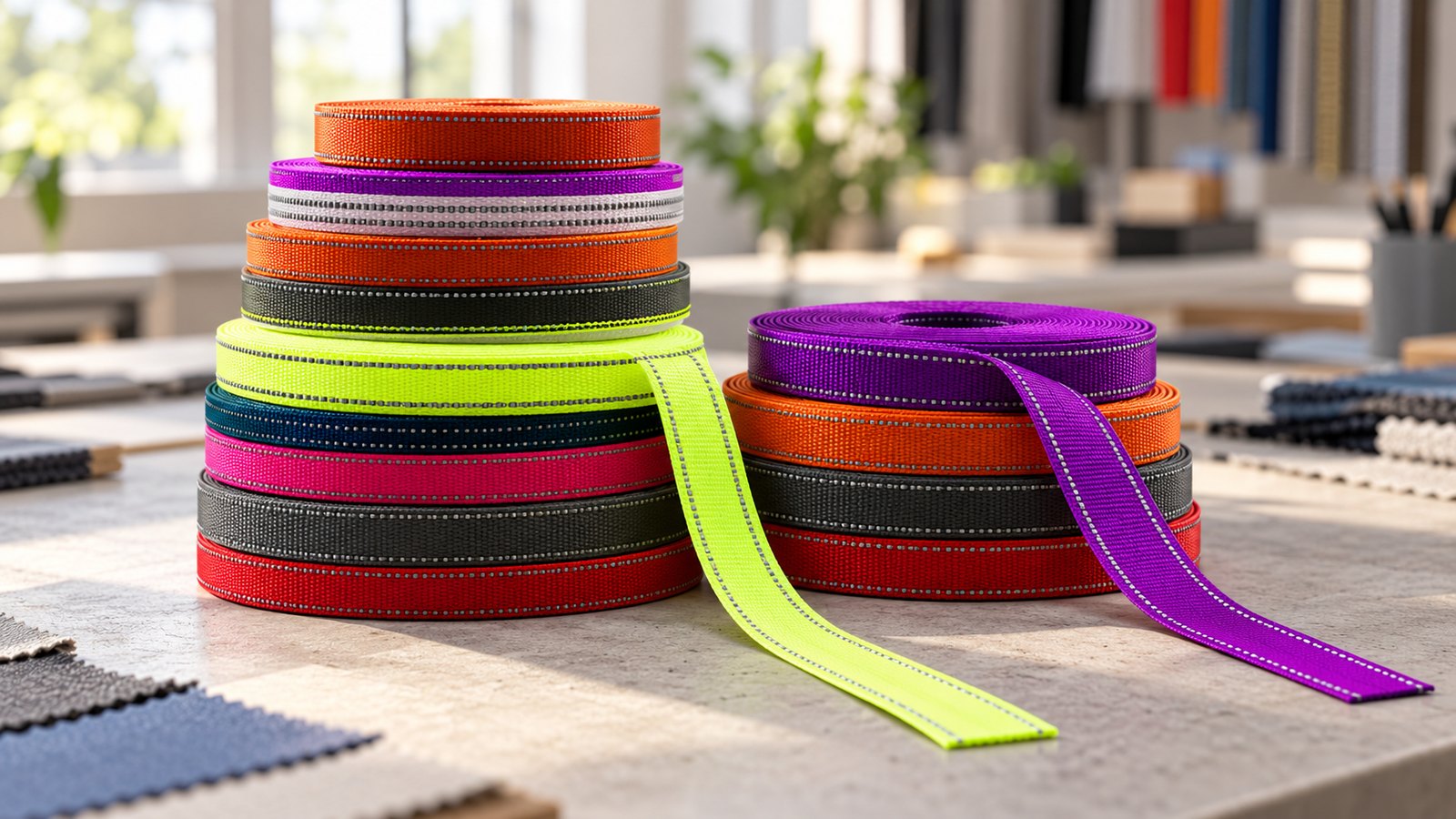
Reflective webbing is a woven strap, usually polyester, nylon or polypropylene, that carries a retroreflective element: a woven-in reflective yarn, a stitched or laminated reflective tape, or a printed reflective ink. It looks like ordinary webbing in daylight and shines back toward headlights at night. Brands use it for dog collars and leashes, bag and backpack straps, lanyards, luggage straps, harnesses and the trims of outdoor gear.
This guide is for product developers and buyers who order reflective webbing by the roll or as finished straps from a factory. It explains the main constructions, how to choose the base yarn and width, which tests to put in the specification, and what to send with your enquiry. If you are working with reflective trims on garments rather than straps, see our guide to reflective tape for clothing.
Four Ways to Make Webbing Reflective
“Reflective webbing” covers several quite different products. The construction decides how bright the strap is, how it feels, how it wears and what it costs, so agree on it before you compare prices.
| Construction | How it is made | Strengths | Watch points |
|---|---|---|---|
| Woven-in reflective yarn | Reflective yarn woven into the strap as stripes, edges or a jacquard pattern | Soft, flexible, no layer to peel; patterns and logos can be woven in | Lower brightness than tape because the reflective area is smaller |
| Reflective tape sewn on | A narrow reflective fabric tape stitched along the centre of the webbing | High brightness; easy to change tape colour or grade | Stitch lines and edges can wear; adds stiffness |
| Reflective film heat-laminated | Reflective heat-transfer film bonded to the strap surface | Clean look, no stitching, good for printed patterns | Adhesion must be checked after washing and flexing |
| Reflective ink printed | Screen-printed reflective ink in a logo, text or repeat pattern | Lowest set-up for branding; works on lanyards and promotional straps | Brightness and abrasion resistance depend heavily on the ink and coverage |
Woven and printed reflective structures are explained in more detail in our article on reflective yarn vs reflective thread, and the optics of glass-bead materials in how reflective fabric works.
Choosing the Base Webbing
Fibre
- Polyester: the most common choice for reflective webbing. It stretches little, resists sunlight well and holds colour, which suits leashes, bag straps and luggage straps.
- Nylon: softer and more elastic, with good abrasion resistance. It absorbs more water and stretches more when wet, which some pet and outdoor products accept for the softer hand.
- Polypropylene: light and low cost, and it floats, but it is less resistant to sunlight and heat. Common for budget bags and promotional items.
Width, thickness and weave
Straps are made in many widths; 20, 25, 38 and 50 mm are typical for collars, leashes and bag straps, and narrower widths are used for lanyards and trims. Specify the width that fits your buckles and sliders, then the thickness and the weave (plain, twill, herringbone or tubular). The hardware supplier and the webbing supplier must work to the same width tolerance, otherwise buckles slip or jam.
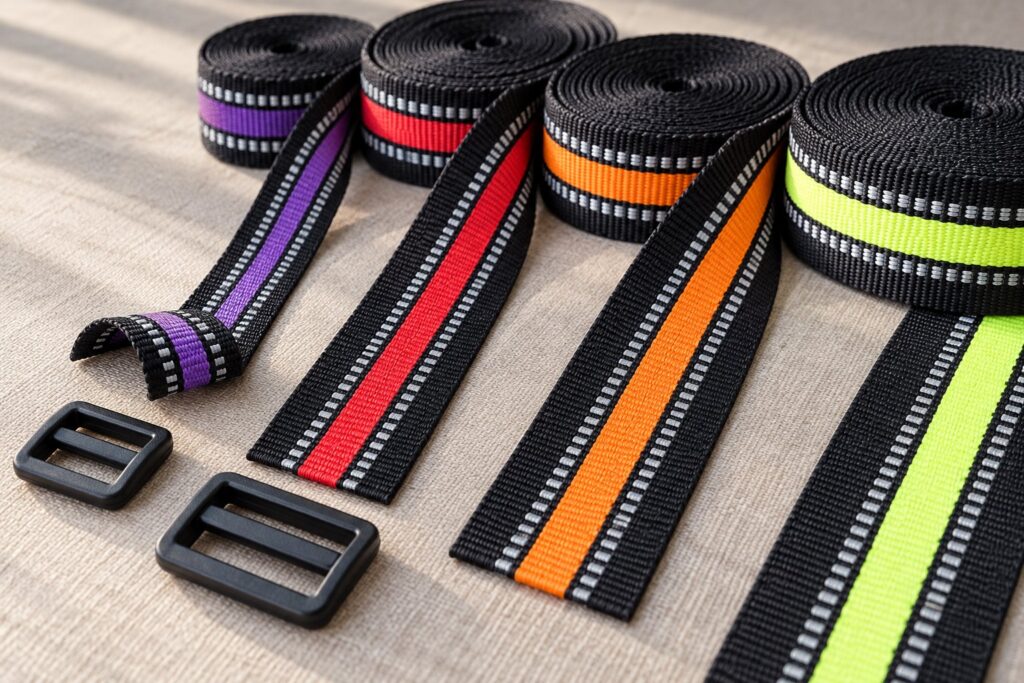
Where Reflective Webbing Is Used
- Pet products: collars, leashes and harnesses are the biggest category. Walks often happen early in the morning or after dark, so reflective trim is a selling point. See our reflective dog leash.
- Bags and backpacks: shoulder straps, grab handles and drawstrings. Reflective webbing adds night visibility without changing the bag body. Compare our reflective drawstring bags.
- Lanyards and ID straps: printed reflective webbing for events, schools and site passes. Our guide to custom reflective lanyards covers printing and attachments, and an example is our polyester webbing lanyard with reflective tape.
- Luggage and cargo straps: bright colours and reflective stripes help travellers spot their bags and make straps visible in dim loading areas.
- Apparel and accessories: belts, sashes, armbands and trims on outdoor clothing.
Not for life-safety equipment. Climbing slings, fall-protection harnesses, vehicle seat belts and child restraints are certified as complete products under their own standards. Decorative or promotional reflective webbing should not be used as a substitute for certified webbing in those uses.
Tests to Put in Your Specification
Webbing that looks right on the sample can still fail in use. Agree the tests and pass levels with the factory before bulk production:
- Breaking strength and elongation: measured on the webbing and, for finished straps, on the stitched joints and hardware. ASTM D6775 is a common test method for webbing. Set the requirement from your product’s real loads.
- Reflective performance: ask for the coefficient of retroreflection of the reflective element, measured at stated angles, and repeat the measurement after washing or abrasion if the product will be washed.
- Colour fastness: to light (ISO 105-B02) for outdoor products, and to washing (ISO 105-C06) or rubbing for collars and straps that touch skin, fur and clothing.
- Adhesion and durability: for laminated film and printed ink, check for peeling, cracking and loss of brightness after flexing, washing and abrasion.
- Chemical requirements: state the regulations or certificates your market needs, for example REACH in the EU, and whether you want an OEKO-TEX Standard 100 certificate for skin-contact items.
How to Order: Rolls or Finished Straps
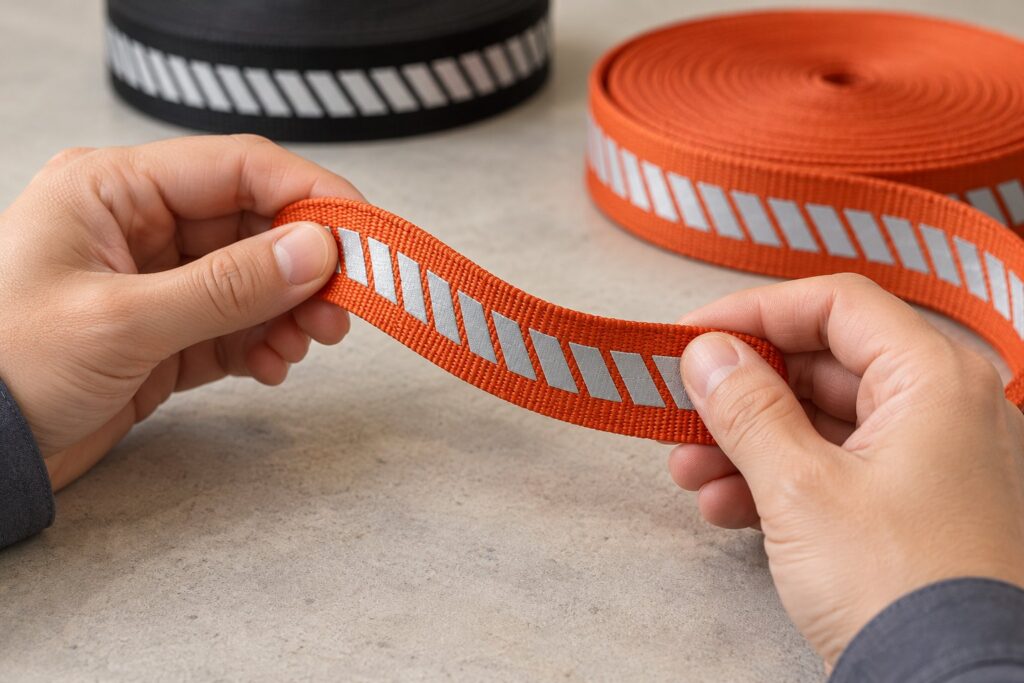
- By the roll: for brands that sew their own products. Specify width, thickness, colour, construction, reflective layout, roll length and how the rolls are packed and labelled.
- Cut and finished: for collars, leashes, lanyards and luggage straps. Add the cut length, end finishing (heat-sealed, folded and stitched), hardware type and finish, and the stitch pattern for joints.
- Branding: a woven-in logo needs a jacquard design and a sample run; a printed logo needs artwork, ink colours and the printing method. Reflective printing can be combined with normal colour printing on the same strap.
- Samples and approval: approve a physical sample of the webbing and, where relevant, a finished strap with hardware. Keep a signed reference sample for bulk inspection.
Minimum order quantity, colour matching options and lead time depend on the construction and whether the yarn or tape is in stock; we confirm them when you send your enquiry. If you also need reflective fabric for the same product range, read our guide to buying reflective fabric by the yard.
Frequently Asked Questions
Which is brighter, woven reflective yarn or sewn-on reflective tape?
Sewn-on or laminated reflective tape is usually brighter, because more of the strap surface is reflective. Woven reflective yarn gives a softer strap with no layer that can peel, and is a good choice when a subtle effect is enough.
Is reflective webbing as strong as normal webbing?
The strength comes from the base webbing and how it is woven and stitched. A reflective element can change thickness and stiffness, so test the finished strap rather than assuming it matches a plain strap of the same width.
Can reflective webbing be washed?
Most constructions can be washed, but brightness and adhesion can drop with repeated washing, especially for printed ink and laminated film. Agree a wash test on the sample and write care instructions to match.
Is there a standard for reflective dog collars or bag straps?
There is no single product standard for reflective pet webbing or bag straps. Buyers usually specify strength, colour fastness, retroreflection values and chemical compliance for their market, and test against those.
Can YOLITE make reflective webbing with our logo?
Yes. Send the width, colour, construction, logo artwork and intended product, and we will propose woven, printed or tape options and confirm MOQ and lead time.
Request a Reflective Webbing Quote
Tell YOLITE what the strap is for, the width and hardware you use, the reflective look you want and your target market. We can supply reflective webbing by the roll or as finished straps, lanyards and pet accessories. Contact us with a sketch, photo or reference sample.
Sources and Scope
1. ASTM International, “ASTM D6775 — Standard Test Method for Breaking Strength and Elongation of Textile Webbing, Tape and Braided Material.”
2. ISO, “ISO 105-B02 — Colour fastness to artificial light: Xenon arc fading lamp test”; “ISO 105-C06 — Colour fastness to domestic and commercial laundering.”
3. CIE, “CIE 54.2:2001 — Retroreflection: definition and measurement.”
4. European Union, Regulation (EC) No 1907/2006 (REACH); OEKO-TEX Association, “OEKO-TEX Standard 100.”
This article is a sourcing guide, not a substitute for the complete standards and regulations or for testing by an accredited laboratory. Reflective webbing described here is not intended for climbing, fall protection, vehicle restraint or other life-safety uses.

AUTHOR
Jack Lee
Founder · Yolite Industrial Co., Ltd.
Reflective-products specialist since 2003, focused on reflective materials, high-visibility apparel, OEM customization, and practical product development for international buyers.