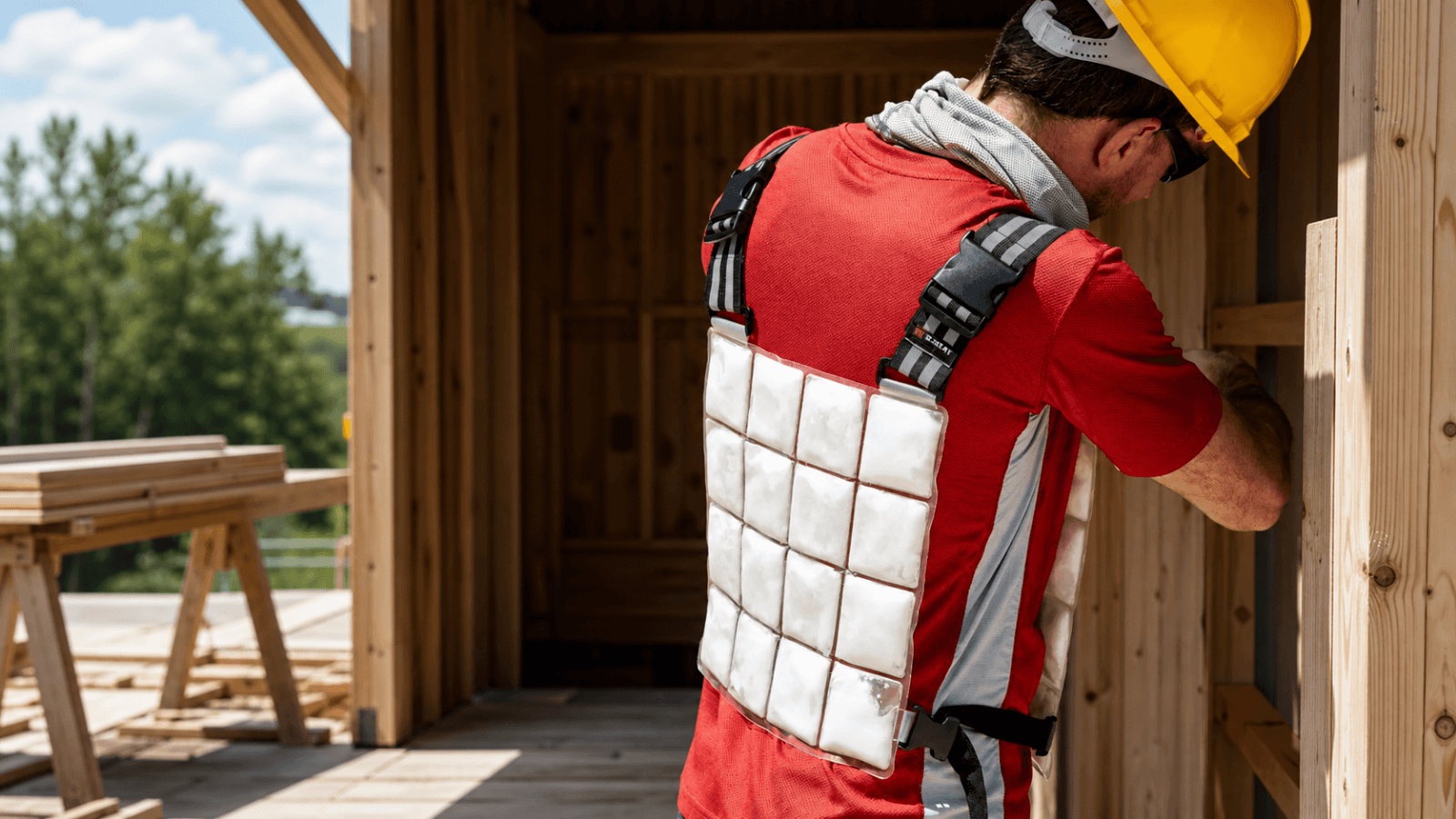
A PCM cooling vest uses phase change material packs to absorb heat near a designed transition temperature. Unlike an evaporative vest, it does not depend on moving air or low humidity. Unlike a fan vest, it needs no battery while it is being worn. That makes PCM systems useful for some construction, warehouse, manufacturing and outdoor tasks—but the vest is only one part of a complete heat-safety plan.
This guide explains the basic science, the practical trade-offs and the questions a buyer should ask before choosing a phase change cooling vest for work.
Quick summary
- PCM packs absorb heat as their material changes phase at a selected temperature.
- The cooling temperature, pack mass, coverage and working conditions all affect how a vest feels and how long it lasts.
- PCM can work in humid or still-air environments where evaporation is less effective.
- The packs add weight and must be reconditioned before reuse.
- A cooling vest does not replace water, rest, shade, acclimatization, work-rest planning or emergency procedures.
How a PCM cooling vest works
Phase change material stores and releases thermal energy during a change of state. In a cooling vest, sealed packs are first conditioned below their transition temperature. As the packs warm while being worn, the material absorbs heat during the phase change. This helps hold the pack near its designed transition temperature until much of the phase change is complete.
The idea is easier to understand by comparing it with ordinary ice. Ice also absorbs heat while melting, but it changes phase near 0°C / 32°F. Many wearable PCM products are designed to transition at a warmer temperature. A warmer pack may feel less intense against the body and can reduce condensation compared with very cold ice, although the actual experience depends on the pack design, clothing layers and environment.
“PCM” is a technology category, not a single performance specification. Two vests can use different transition temperatures, pack shapes, pack quantities and torso coverage. Buyers should therefore compare the complete system instead of assuming every PCM vest performs the same way.
PCM cooling vests versus other cooling technologies
PCM packs versus ice or frozen gel packs
Ice and deeply frozen gel packs can deliver strong initial cooling, but they may feel uncomfortably cold without adequate insulation. They can also produce condensation as humid air contacts a cold surface. PCM packs designed for a warmer transition point typically provide a more moderate temperature profile. The trade-off is that cooling capacity and duration vary with pack mass and operating conditions.
PCM cooling vests versus evaporative vests
Evaporative garments use water evaporation to remove heat. They are often light and simple, but their performance depends on evaporation. High humidity, limited airflow or additional impermeable PPE can reduce that effect. A phase change cooling vest does not rely on evaporation, so it can be a better candidate for humid or indoor settings. It is usually heavier because the wearer carries multiple packs.
PCM cooling vests versus fan or air-cooled garments
Fan garments move air under clothing, while supplied-air systems can deliver cooled air through a hose. These approaches may provide longer active cooling when power or compressed air remains available. PCM is self-contained during use, but the packs eventually warm and must be swapped or reconditioned. The right choice depends on mobility, power access, airflow, required PPE and the length of the task.
Where phase change cooling vests fit in a heat-safety program
Cooling PPE should support a broader control plan, not become the plan itself. OSHA’s heat-control guidance places engineering controls and changes to work practices ahead of personal cooling equipment. Examples include cooling the work area, reducing manual effort, scheduling work during cooler periods, providing rest breaks, supplying fluids and using a buddy system.
OSHA also notes that jackets or vests with reusable ice packs or phase change packs may be used in extremely hot conditions. At the same time, OSHA warns that some PPE and clothing can increase heat risk by limiting heat loss. This is why a vest should be assessed together with the worker’s full clothing and PPE system.
NIOSH describes occupational heat stress as the combined effect of metabolic heat, environmental heat, clothing and PPE. That definition matters: a vest may change one part of the equation, but workload, humidity, sunlight, radiant heat, acclimatization and individual health still require attention.
How to choose a PCM cooling vest for work
1. Match the transition temperature to the task
Ask the supplier for the PCM transition temperature and the conditions under which the claimed cooling duration was measured. A lower-temperature pack is not automatically better. It may feel too cold, create more condensation or require more demanding reconditioning. A warmer-temperature pack may feel gentler but provide a different cooling effect.
2. Compare pack coverage and weight distribution
Review where the packs sit on the front, back and sides of the torso. Broad coverage can increase cooling capacity, but it also adds mass and may restrict movement. Shoulder and waist adjustment should distribute the load without interfering with bending, climbing or tool use.
3. Check compatibility with required PPE
A cooling vest must not compromise fall-protection harnesses, high-visibility garments, flame-resistant clothing, respirators or other required equipment. Confirm the intended layer order and conduct a task-specific trial. A generic product description cannot replace a workplace hazard assessment.
4. Plan pack reconditioning and rotation
Ask how the packs are conditioned, how long that process takes and whether a refrigerator, freezer, ice-water bath or cool room is required. For long shifts, calculate how many spare sets are needed and where used packs will be reconditioned. A vest that works well for one cycle can still fail operationally if there is no practical swap plan.
5. Verify cleaning, inspection and replacement instructions
Reusable packs should be checked for leaks, swelling, damaged seams or other changes specified by the manufacturer. The garment needs instructions for removing packs, washing, drying and storage. Shared workplace vests also need a hygiene process between users.
A real product specification example
Yolite’s PCM Cooling Vest for Long Lasting Cooling uses 30 reusable PCM packs in an adjustable vest made with breathable composite fabric. The published product information states that the system requires no electricity, has adjustable shoulder and waist sections, and is intended for outdoor work, construction, sports and industrial environments.
The same product page describes an approximate cooling period of one hour or longer depending on conditions, with a stated freezing time of roughly 0.5–3 hours. Those figures are model-specific rather than universal PCM performance. Buyers should confirm the test conditions, pack transition temperature, sizing, total loaded weight and reconditioning method for their intended use.
Common mistakes when buying a phase change cooling vest
- Comparing duration without test conditions. Air temperature, radiant heat, workload, clothing and pack preparation can change runtime.
- Ignoring loaded weight. A vest that feels acceptable for ten minutes may affect mobility over a full work cycle.
- Assuming “cooling” means heat-hazard control is complete. Water, rest, shade, acclimatization, supervision and emergency response still matter.
- Skipping a compatibility trial. The vest must work with the actual PPE ensemble and job movements.
- Buying without a pack-rotation plan. Recharge logistics determine whether the system remains useful across a shift.
Frequently asked questions about PCM cooling vests
How long does a PCM cooling vest stay cool?
There is no universal duration. Runtime depends on pack chemistry, transition temperature, pack mass, coverage, starting condition, ambient heat, radiant heat, airflow, workload and clothing. Use the supplier’s tested conditions as the basis for comparison.
Does a PCM cooling vest need a freezer?
Not always. The required conditioning method depends on the PCM transition temperature and product design. Some systems can be reconditioned in a refrigerator, cool room or ice water, while others specify freezing. Follow the exact manufacturer instructions.
Can a cooling vest prevent heat stroke?
A vest should not be presented as a guarantee against heat illness. Heat risk requires engineering controls, work practices, hydration, rest, acclimatization, training, symptom recognition and emergency action. Anyone showing signs of heat stroke needs immediate cooling and emergency medical help.
Does PCM work in humid environments?
PCM cooling does not depend on water evaporating from the garment, so humidity does not limit it in the same way it can limit evaporative cooling. However, humidity still increases overall heat stress and remains part of the workplace risk assessment.
What should a bulk buyer request from a supplier?
Request the transition temperature, pack count and mass, loaded vest weight, size range, materials, cooling-duration test conditions, conditioning method, cleaning instructions, replacement-pack availability, packaging options and sample policy.
Conclusion
A PCM cooling vest can provide portable, self-contained cooling without relying on airflow or power during use. Its real value depends on choosing the right transition temperature, coverage, weight and recharge plan—and integrating the vest into a complete heat-safety program. For OEM or bulk requirements, review the Yolite cooling safety vest range and confirm specifications against the intended task before ordering.

AUTHOR
Jack Lee
Founder · Yolite Industrial Co., Ltd.
Reflective-products specialist since 2003, focused on reflective materials, high-visibility apparel, OEM customization, and practical product development for international buyers.
View LinkedIn Profile