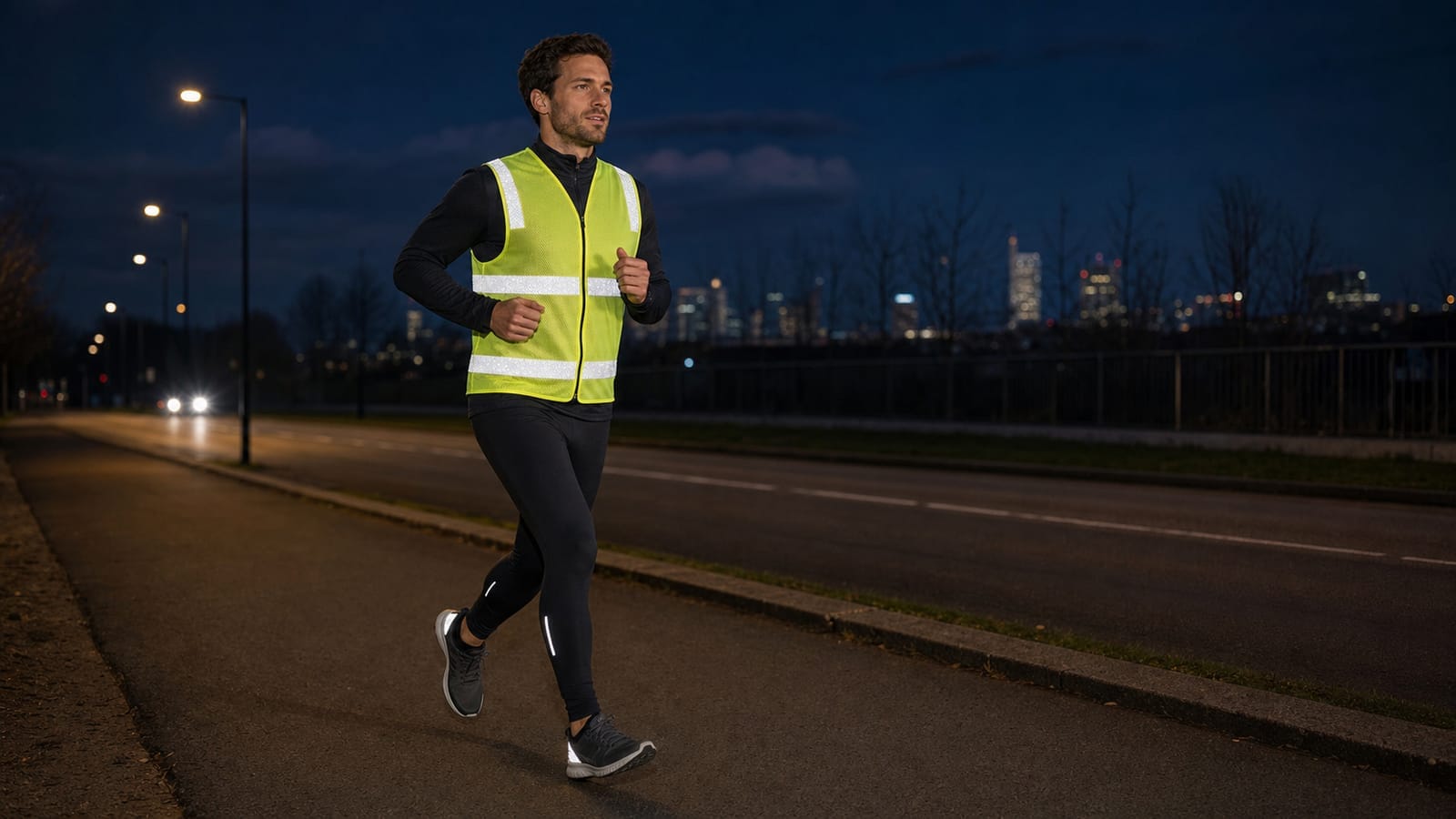
Reflective gear for night running helps vehicle headlights reveal a runner sooner and makes the runner’s movement easier to recognize. A reflective vest creates a visible area on the torso, while reflective details on moving legs, ankles, and shoes can form a human-motion pattern known as *biomotion*. The strongest approach is therefore not one bright logo, but a coordinated visibility system across the upper and lower body. Reflective clothing improves conspicuity; it does not guarantee that every driver will see the runner or prevent a collision.
How Retroreflective Material Works at Night
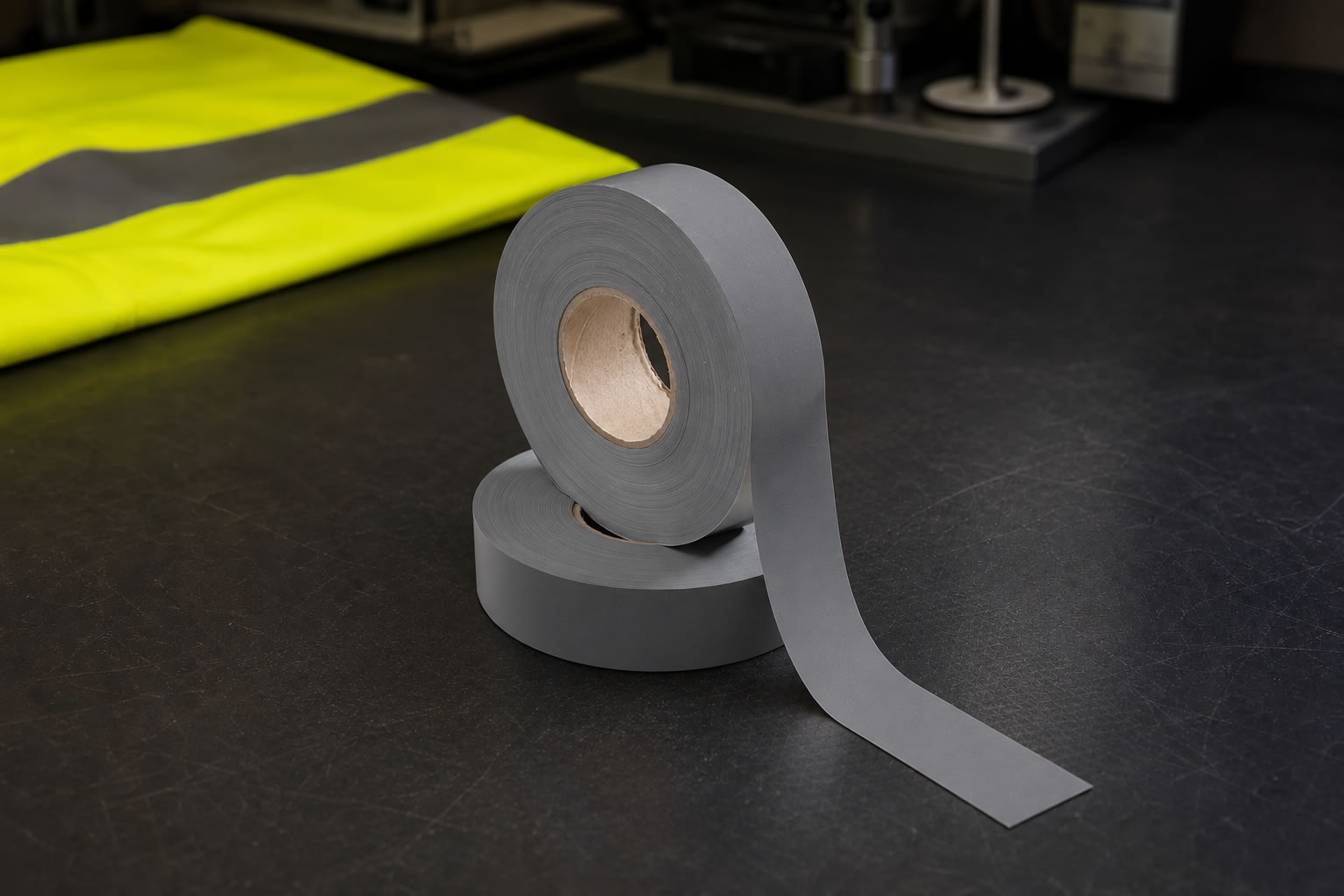
Retroreflective material is designed to return a portion of incoming light toward its source. When vehicle headlights illuminate suitable reflective trim, more light travels back toward the driver than it would from ordinary dark fabric. That is why a silver-gray strip can appear dramatically brighter from near the headlight direction without containing a battery or producing light by itself.
This mechanism is different from fluorescent color. Fluorescent yellow, orange, and similar colors can increase contrast in daylight, dawn, dusk, or overcast conditions. In darkness, however, retroreflective material is the feature intended to respond to headlights. A practical night-running garment may use both: a bright fabric for low-light contrast and retroreflective details for headlight illumination.
The effect is still conditional. Reflective performance depends on whether light reaches the material, the angle between the light, runner, and observer, the amount and orientation of reflective area, weather, dirt, wear, and whether the material is covered by another layer.
Why a Reflective Running Vest Helps—but Is Not the Whole System
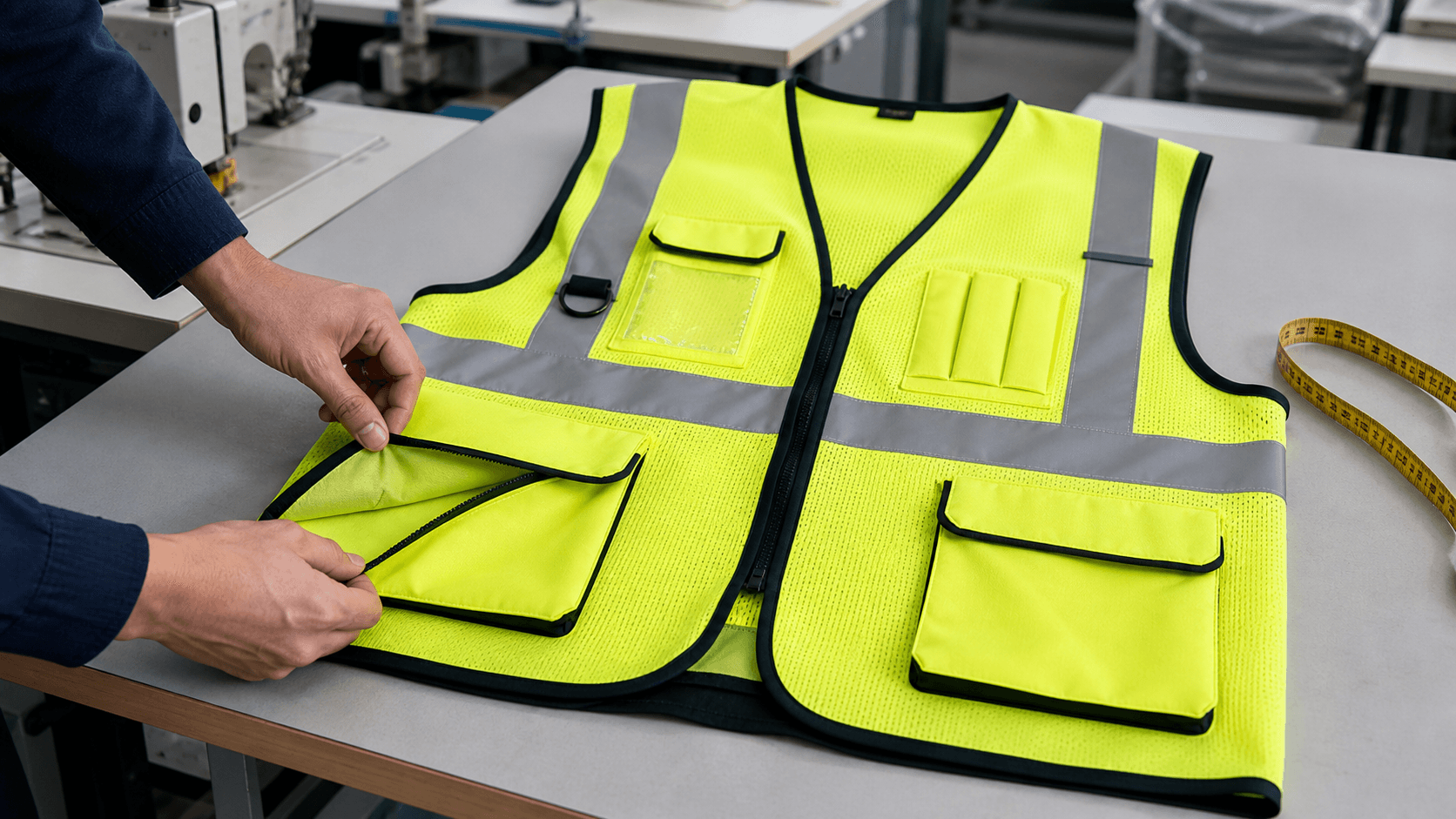
A lightweight reflective running vest can add a meaningful visible area to the front, back, and sides of the torso. It can also be worn over different seasonal layers, making it a flexible part of a night-running kit. For OEM design, the vest should fit close enough to avoid excessive bouncing while preserving ventilation and natural arm movement.
However, a vest mainly marks the torso. A driver initially seeing a bright patch still needs to identify it as a person and understand how that person is moving. Controlled nighttime studies have found that reflective markers on moving limbs can improve pedestrian recognition compared with torso-only markings. The moving pattern of knees and ankles provides information that a static torso patch cannot provide on its own.
This does not make the vest unnecessary. It means the vest and moving-limb details have complementary jobs: the torso provides a larger central target, while lower-body reflectors help communicate human gait and direction.
Why Reflective Details Belong on Pants, Ankles, and Shoes
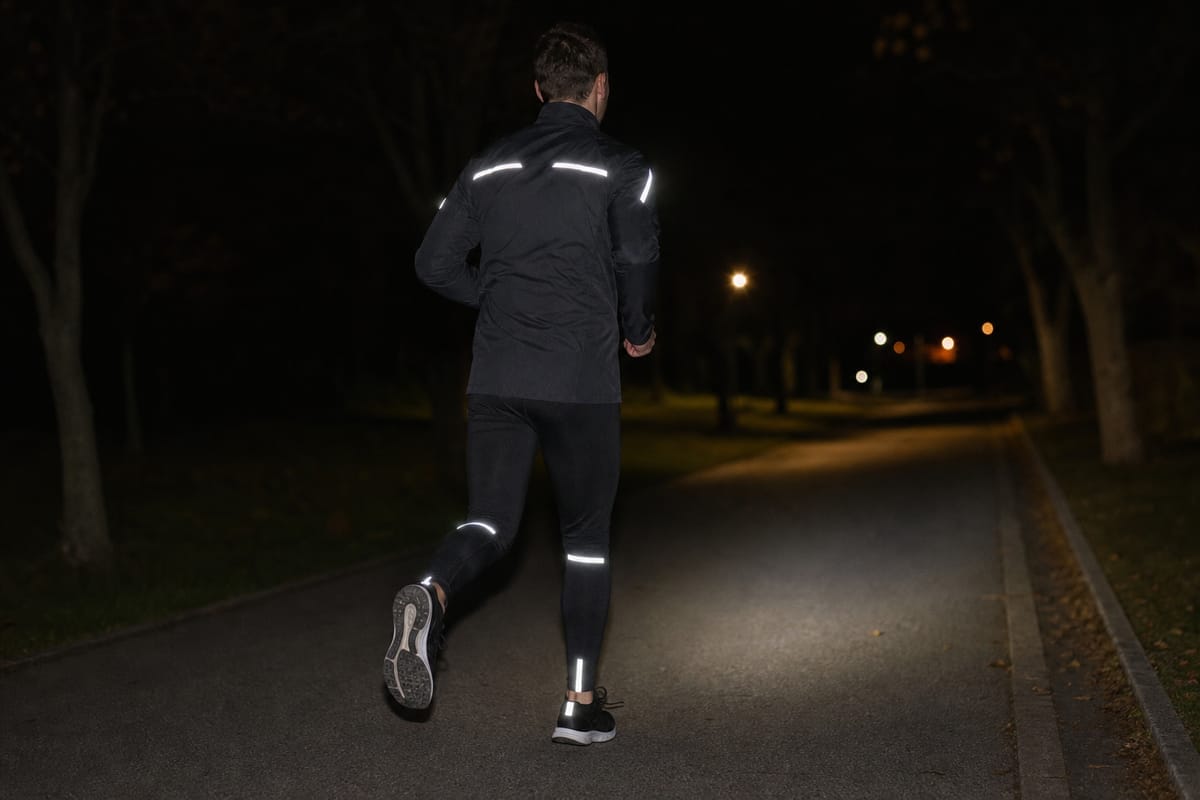
During running, the legs repeatedly extend, cross, rise, and return. Reflective elements placed near the knees, calves, ankles, and shoe heels move through a rhythm associated with a human stride. Researchers describe this recognizable movement pattern as biomotion.
This is why reflective running tights or pants should do more than carry a small decorative logo near the hip. Well-positioned details on both legs can remain visible through different phases of the stride. Ankle bands or reflective heel and side panels on shoes can add motion cues close to the ground, especially when they are not hidden by the trousers.
A 1996 controlled field study reported longer nighttime recognition distances for limb-mounted reflector configurations than for torso-mounted reflectors. Later closed-road research also found advantages when reflective markers described the movement of major joints. These experiments measured detection or recognition under particular test conditions; they should guide placement decisions, not be converted into a guaranteed visibility distance for every runner.
Where Should Reflective Elements Be Placed?
Good reflective running clothing distributes useful reflective area instead of concentrating everything in one small patch.
| Location | What it contributes | Practical design check |
|---|---|---|
| Front, back, and sides of torso | A central visible area from several approach directions | Use continuous, correctly oriented trim that stays visible when the garment is worn |
| Sleeves or wrists | Upper-limb motion and additional side visibility | Keep paired details balanced and clear of cuffs, watches, or outer layers |
| Knees and calves | Repeating stride movement that supports biomotion recognition | Position details on both legs without restricting stretch or joint movement |
| Ankles and shoe heels/sides | Fast, distinctive motion near the ground | Ensure trouser hems do not cover the reflectors and avoid tiny decorative-only patches |
The goal is not to cover every surface. It is to create enough well-positioned information for an observer to notice a person and interpret the motion. Front-only decoration leaves gaps when traffic or cyclists approach from behind or the side. Designers should therefore consider the complete worn outfit, not evaluate a flat garment in isolation.
What to Look for in Reflective Running Gear
When choosing or specifying night running safety gear, check the following:
1. Relevant placement: Look for reflective area on the torso and moving lower limbs, not only a small chest mark.
2. Multiple viewing directions: Inspect the front, back, and side views of the complete outfit.
3. Secure construction: Heat-transferred or sewn trim should lie flat and follow the garment without peeling, twisting, or interrupting stretch zones.
4. Running comfort: The vest, jacket, or tights should allow natural stride and arm swing, manage moisture, and avoid chafing or excessive bounce.
5. Realistic material claims: Reflective trim needs an external light source. It should not be marketed as self-illuminating unless the product actually contains an active lighting system.
6. Care durability: Washing, abrasion, dirt, and repeated flexing can affect appearance and performance. Follow the finished garment’s verified care and test information.
Reflective details on shoes are useful as part of this system, but a small shoe patch should not be treated as a replacement for upper-body and leg visibility. Likewise, a vest alone should not be presented as a complete solution if the rest of the runner is difficult to recognize.
What Reflective Gear Cannot Do
Reflective material improves the opportunity to be detected and recognized; it cannot control driver attention, vehicle speed, blind corners, weather, headlight condition, or the direction from which light arrives. The U.S. National Highway Traffic Safety Administration notes that conspicuity measures cannot overcome hazards such as distraction, and research has not established that visibility aids by themselves reduce pedestrian crashes.
Night runners should combine reflective clothing with safer route and behavior choices: use sidewalks or separated paths where available, choose well-lit routes, remain alert at crossings and driveways, and follow local rules when running near a road. A headlamp or active light can complement passive reflectors by helping the runner see and by providing light when vehicle headlights are absent, but it does not remove the need for situational awareness.
Recreational running apparel should also not be described as ISO 20471 or EN 17353 compliant unless the exact finished product has been assessed and documented for the applicable standard and type or class.
A Practical Night-Running Visibility Checklist
Before heading out, ask:
• Can reflective material be seen from the front, back, and sides?
• Is there a meaningful visible area on the torso?
• Do both legs include reflective details near moving joints or lower legs?
• Are ankle or shoe reflectors uncovered?
• Are the reflective surfaces clean and in good condition?
• Does the complete outfit fit securely without restricting movement?
• Is the route appropriate, and is an active light needed?
The key design lesson is simple: effective reflective gear for night running combines a visible torso with reflective cues on moving parts of the body. A vest helps establish presence; reflective pants, ankle details, and shoes help communicate that the bright shape is a moving runner. Used together—and combined with safer night-running behavior—these elements can make the runner easier to detect and understand in low light.
Sources
1. NHTSA — Conspicuity Enhancement
2. UK Department for Transport — Highway Code, Rules for Pedestrians
3. Kwan & Mapstone — Interventions for increasing pedestrian and cyclist visibility, Cochrane review
4. Effects of retroreflector positioning on nighttime recognition of pedestrians
5. Configuring retroreflective markings to enhance night-time conspicuity
6. Night-time pedestrian conspicuity: effects of clothing on drivers’ eye movements
7. Using retro-reflective cloth to enhance drivers’ judgment of pedestrian walking direction

AUTHOR
Jack Lee
Founder · Yolite Industrial Co., Ltd.
Reflective-products specialist since 2003, focused on reflective materials, high-visibility apparel, OEM customization, and practical product development for international buyers.
View LinkedIn Profile