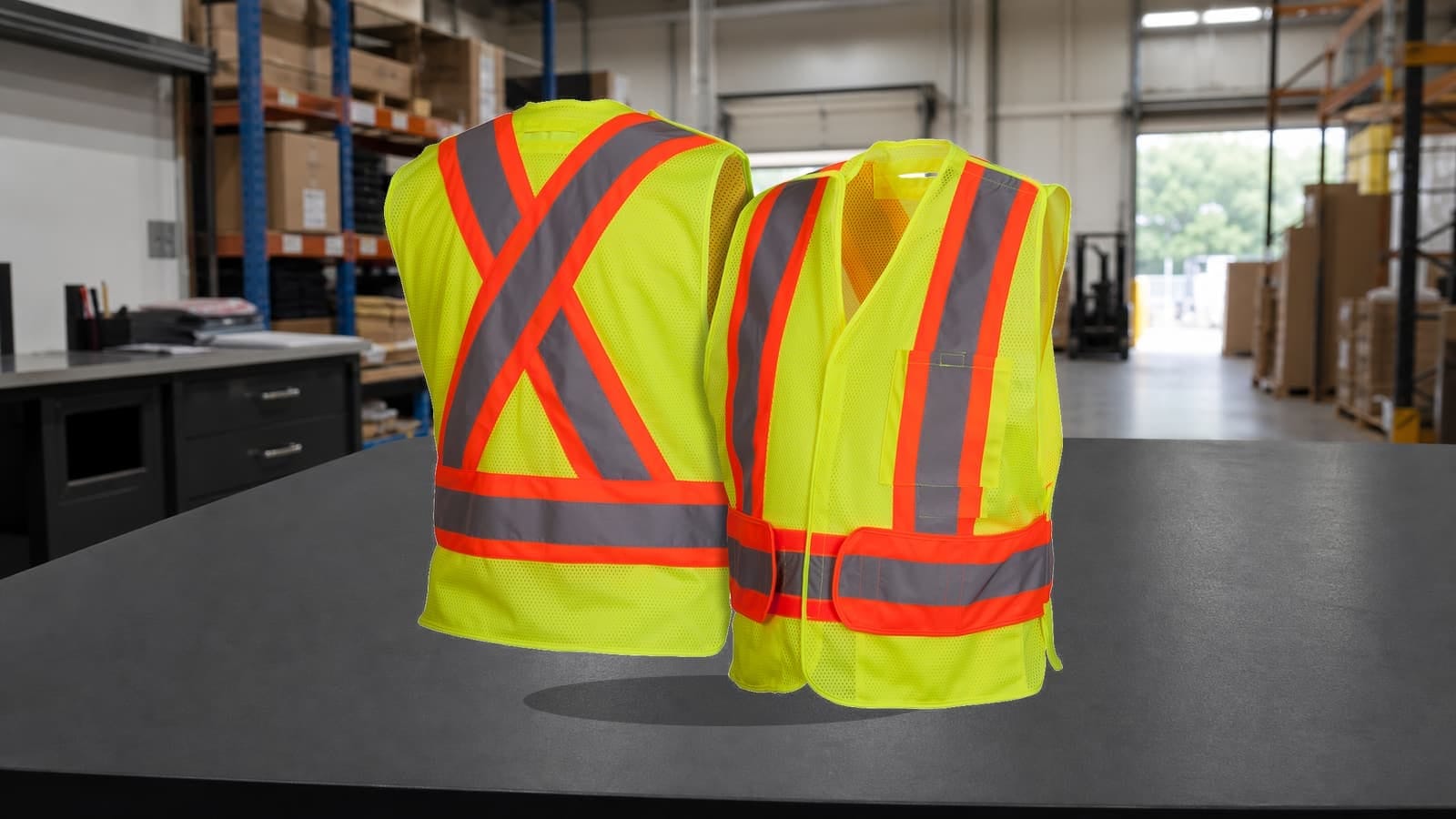
A breakaway safety vest is a high-visibility garment built with releasable connection points so the vest can separate if it is caught by equipment, cargo, fencing, or another obstruction. A typical 5-point breakaway safety vest releases at both shoulders, both sides, and the front closure. For buyers, the key distinction is simple: breakaway construction addresses a snagging or entanglement hazard, while ANSI/ISEA 107 or CSA Z96 compliance addresses visibility performance; one does not automatically prove the other.
What Is a Breakaway Safety Vest?
A breakaway safety vest—also called a tear-away safety vest—uses deliberately releasable closures instead of permanently sewn connections at selected points. Hook-and-loop fasteners are common, although the exact closure construction should be confirmed in the product specification.
The purpose is to give the garment a way to separate from the wearer when an external force catches it. That feature can be relevant in warehouses, rail yards, roadside operations, baggage handling, material-handling areas, and other workplaces where people work near moving equipment or snag points. It is an additional PPE design choice, not a substitute for machine guarding, pedestrian separation, traffic controls, training, or a site-specific hazard assessment.
The Canadian Centre for Occupational Health and Safety advises employers to assess work activities, worker interaction with mobile equipment, traffic speed, sightlines, lighting, and existing engineering or administrative controls before selecting high-visibility apparel. Its guidance also identifies tear-away features among the garment properties that may be required because of other hazards at the workplace.[1]
How Does a 5-Point Breakaway Safety Vest Work?
The term “5-point” normally describes five releasable zones:
1. Left shoulder
2. Right shoulder
3. Left side or waist
4. Right side or waist
5. Center-front closure
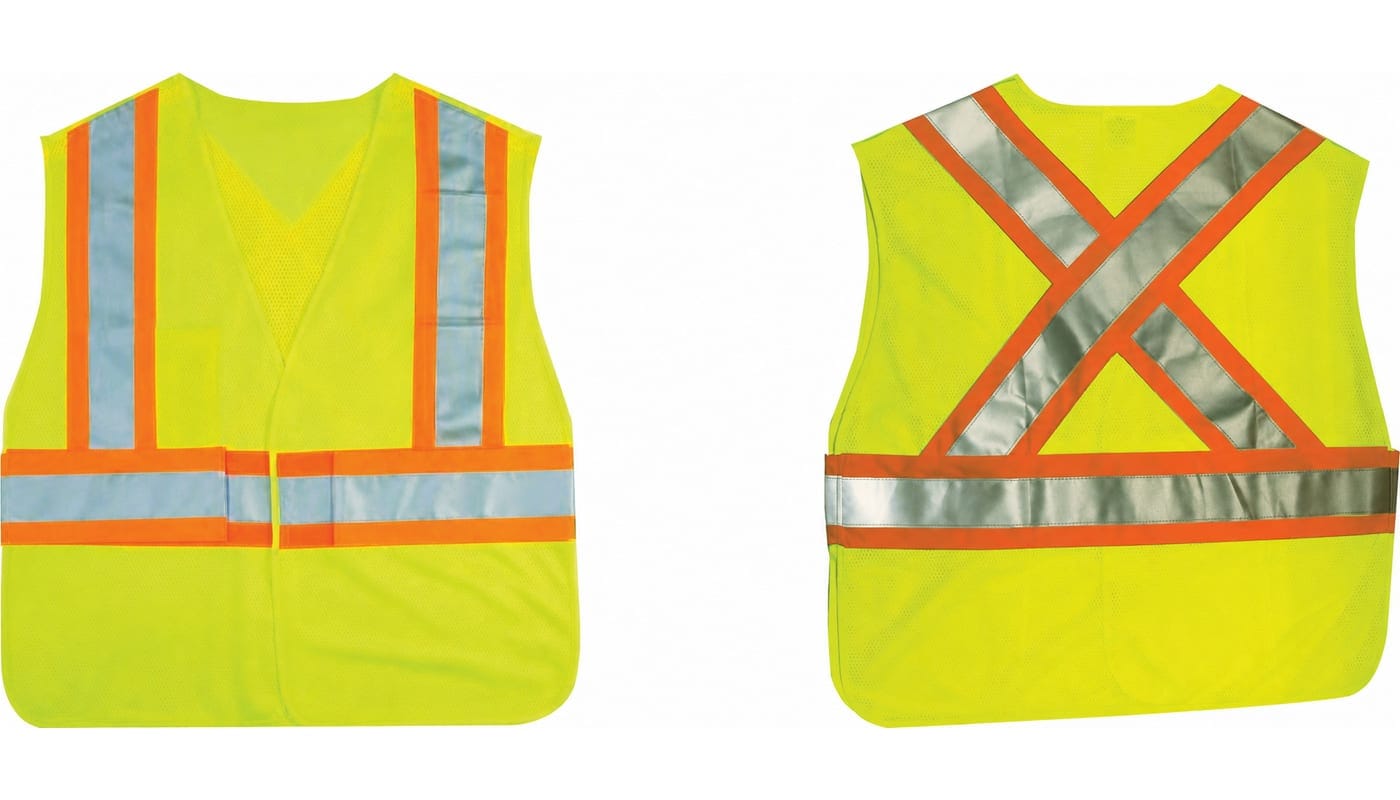
When specifying a vest, do not rely on the phrase “5-point” alone. Ask the supplier for front and rear drawings, close-up photographs of every release point, and a physical sample. Check whether reflective tape bridges a breakaway seam, whether pockets or radio loops restrict release, and whether printing or embroidery has been placed across a releasable joint. A design can appear correct in a catalog image yet behave differently after accessories or branding are added.
Breakaway closures are designed to release under force, but the release force is not universal. It can vary with fastener area, fastener grade, sewing pattern, contamination, laundering, temperature, and the direction of the pull. Unless a supplier provides a documented test method and acceptance range, buyers should not describe the product using a precise release-force claim.
Breakaway Vest vs. Standard Safety Vest: How Should You Choose?
The right choice starts with the hazard assessment, not with a product label.
| Selection question | What it means for the buyer |
|---|---|
| Are there conveyors, rotating equipment, protrusions, cargo edges, rail equipment, or other snag points? | A breakaway design may reduce the consequence of the outer garment being caught, but the underlying hazard must still be controlled. |
| Do workers operate within a road right-of-way or temporary traffic-control zone? | Specify the required high-visibility type and performance class separately; do not assume “breakaway” means ANSI compliant. |
| Is the work in Canada or for a Canadian customer? | Confirm the applicable jurisdiction and whether CSA Z96 is required. CSA and ANSI class systems are not interchangeable. |
| Are pockets, mic tabs, ID windows, or custom logos needed? | Confirm they do not cover required visible material or bridge a release point. Review an approved pre-production sample. |
| Is flame resistance required? | A standard polyester breakaway vest should not be treated as flame-resistant. Specify the correct FR standard and obtain supporting documentation. |
| Will the garment be washed and reused? | Validate closure performance, dimensional stability, color, and retroreflective performance after the required care cycles. |
A conventional, non-breakaway vest may be appropriate where the hazard assessment identifies visibility as the main garment requirement and does not identify a meaningful snagging exposure. A breakaway vest may be the better option where snagging is credible and the employer’s PPE program calls for a releasable outer garment. Neither choice eliminates the need to keep workers separated from moving vehicles and equipment.
Does a Breakaway Safety Vest Meet ANSI/ISEA 107?
Not necessarily. Breakaway is a construction feature; ANSI/ISEA 107 is a high-visibility performance standard. ISEA describes ANSI/ISEA 107-2020 as covering the design, performance, and materials of high-visibility safety apparel, including material performance, minimum areas, and placement. The standard uses garment types and performance classes based on the worker’s exposure and work environment.[2]
For U.S. temporary traffic-control zones, the 2023 11th Edition of the Manual on Uniform Traffic Control Devices states that workers within the right-of-way and TTC zone must wear high-visibility safety apparel meeting ANSI/ISEA 107 Performance Class 2 or 3, or an equivalent revision. It also assigns selection of the appropriate class to a person designated by the employer.[3] Buyers should therefore put both requirements on the purchase specification when both apply—for example, “5-point breakaway construction” and “ANSI/ISEA 107-2020 Type R, Performance Class 2,” supported by the proper garment label and supplier documentation.
Do not approve compliance based only on fluorescent color or silver-looking tape. The finished garment must preserve the required areas and placement of compliant background and retroreflective materials. Size grading, pockets, logos, contrasting trim, and breakaway seams can all affect the final configuration.
What About CSA Z96?
For Canadian programs, check the applicable legislation and the current purchasing requirement before ordering. CCOHS explains that CSA Z96 and ANSI/ISEA 107 use different class concepts: CSA classes are based on body coverage, while ANSI/ISEA 107 specifies minimum material areas and garment configurations.[1] A claim such as “ANSI Class 2” should not be silently converted into “CSA Class 2.”
CCOHS also advises purchasers to obtain proof that both the materials and garment design meet the relevant CSA requirements and notes that the garment tag generally states the compliance claim.[1] For an export order, include the market, standard edition, class, size range, and label language in the specification rather than requesting a generic “compliant vest.”
How to Specify a Breakaway Safety Vest for an RFQ
Use a written specification that separates visibility, breakaway construction, and commercial requirements. This makes supplier quotations easier to compare and reduces sample revisions.
1. Define the work environment
State where the vest will be used, the vehicle or equipment interaction, lighting conditions, climate, duration of wear, and known snagging hazards. Include the destination market and any customer-specific PPE policy.
2. State the visibility standard and garment classification
Write the exact standard edition, garment type, and performance class required by the safety assessment. If no certified class is required, say so clearly instead of asking the factory to guess. Request supporting documentation for the finished garment, not only a data sheet for the reflective tape.
3. Define all release points
List the five locations and require drawings or photographs. Specify the preferred closure material, overlap, orientation, and whether the release points must remain accessible while the vest is worn over normal work clothing. If your safety team requires a release-force range, provide the test method and conditioning procedure.
4. Add functional details carefully
List pocket count and type, radio or microphone tabs, ID holders, zipper alternatives, size range, mesh or solid fabric, and preferred color. Any added component should be reviewed for its effect on both the breakaway path and the visible area.
5. Control logos and personalization
Provide artwork dimensions and locations. Ask the supplier to show the logo on the approval drawing and sample. Printing should not obscure required retroreflective or background material, and decoration should not unintentionally connect two sections intended to separate.
6. Approve a sample and inspection plan
Evaluate fit over typical clothing, 360-degree visibility, closure alignment, release-point accessibility, stitching, tape placement, labeling, and packaging. For repeat orders, establish measurable checkpoints and an agreed sample rather than relying on visual similarity alone.
What Should Buyers Test Before a Bulk Order?
A practical pre-production review should cover:
• Garment identity: style number, color, size range, standard claim, label, and destination market match the purchase order.
• Five-point construction: both shoulders, both sides, and the front release independently and can be reassembled correctly.
• Visibility configuration: background material and retroreflective tape dimensions and placement match the approved design and supporting compliance documents.
• Fit and movement: the vest stays correctly positioned during normal work without restricting motion or creating excessive loose material.
• Accessory interaction: pockets, radios, badges, harnesses, and logos do not cover visibility materials or prevent separation.
• Care durability: the garment and closures remain serviceable after the agreed washing or cleaning cycles.
• Packaging and instructions: care information, use limitations, size, and compliance labeling remain legible and consistent.
Testing should reflect the actual risk and contract. A simple pull demonstration can help confirm that all release points function, but it is not a certification test and does not establish a universal breakaway force. When a legal or customer standard applies, use competent testing and current standard documents.
Limitations Buyers Should Know
A breakaway vest is not guaranteed to release in every incident. The direction and speed of the force, the object involved, closure contamination, garment fit, other PPE, and accessories can change the outcome. The feature should therefore be treated as one layer within a broader system of controls.
It also does not provide flame, arc-flash, chemical, cut, or ballistic protection unless the complete garment is specifically designed and documented for that hazard. A high-visibility polyester mesh vest can introduce additional concerns around heat or flame, even if it has five release points.
Finally, standards and workplace rules change. ANSI/ISEA 107-2020 is the current published ISEA high-visibility apparel standard at the time of writing, while a proposed revision was under public review in 2026.[2] Verify the contract, jurisdiction, and current edition before placing a production order.
The Bottom Line for Sourcing Teams
Choose a breakaway safety vest when the hazard assessment identifies a credible snagging exposure and a releasable outer garment is part of the control plan. Specify the five breakaway points separately from the required visibility standard, then validate both on the finished sample. For custom or wholesale projects, a complete RFQ should state the end-use environment, market, standard edition, garment classification, materials, release construction, accessories, branding, testing, and inspection criteria.
Reflective.cn can develop custom high-visibility vest samples for distributors, PPE brands, and industrial programs. Share your target market, required standard, quantities, artwork, pocket layout, and preferred breakaway configuration so the specification can be reviewed before sampling.
Sources
[1] Canadian Centre for Occupational Health and Safety, “High-Visibility Safety Apparel,” revised December 17, 2021 and page updated August 28, 2025. https://www.ccohs.ca/oshanswers/prevention/ppe/high_visibility.html
[2] International Safety Equipment Association, “High-Visibility Safety Apparel Standard Updated to Include Disposable Coveralls, Nighttime Luminance Measurement,” September 28, 2020. https://safetyequipment.org/ansi-isea-107-2020/
[3] Federal Highway Administration, “Manual on Uniform Traffic Control Devices, 11th Edition,” December 2023, Section 6C.05. https://highways.dot.gov/media/111821

AUTHOR
Jack Lee
Founder · Yolite Industrial Co., Ltd.
Reflective-products specialist since 2003, focused on reflective materials, high-visibility apparel, OEM customization, and practical product development for international buyers.
View LinkedIn Profile