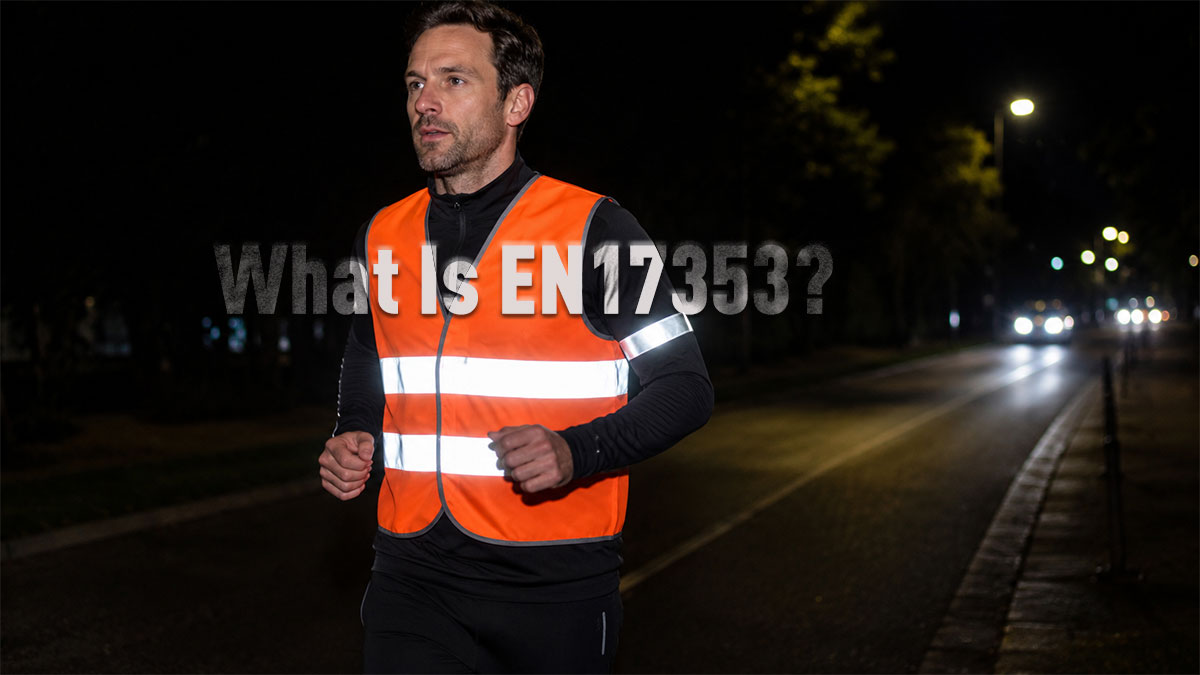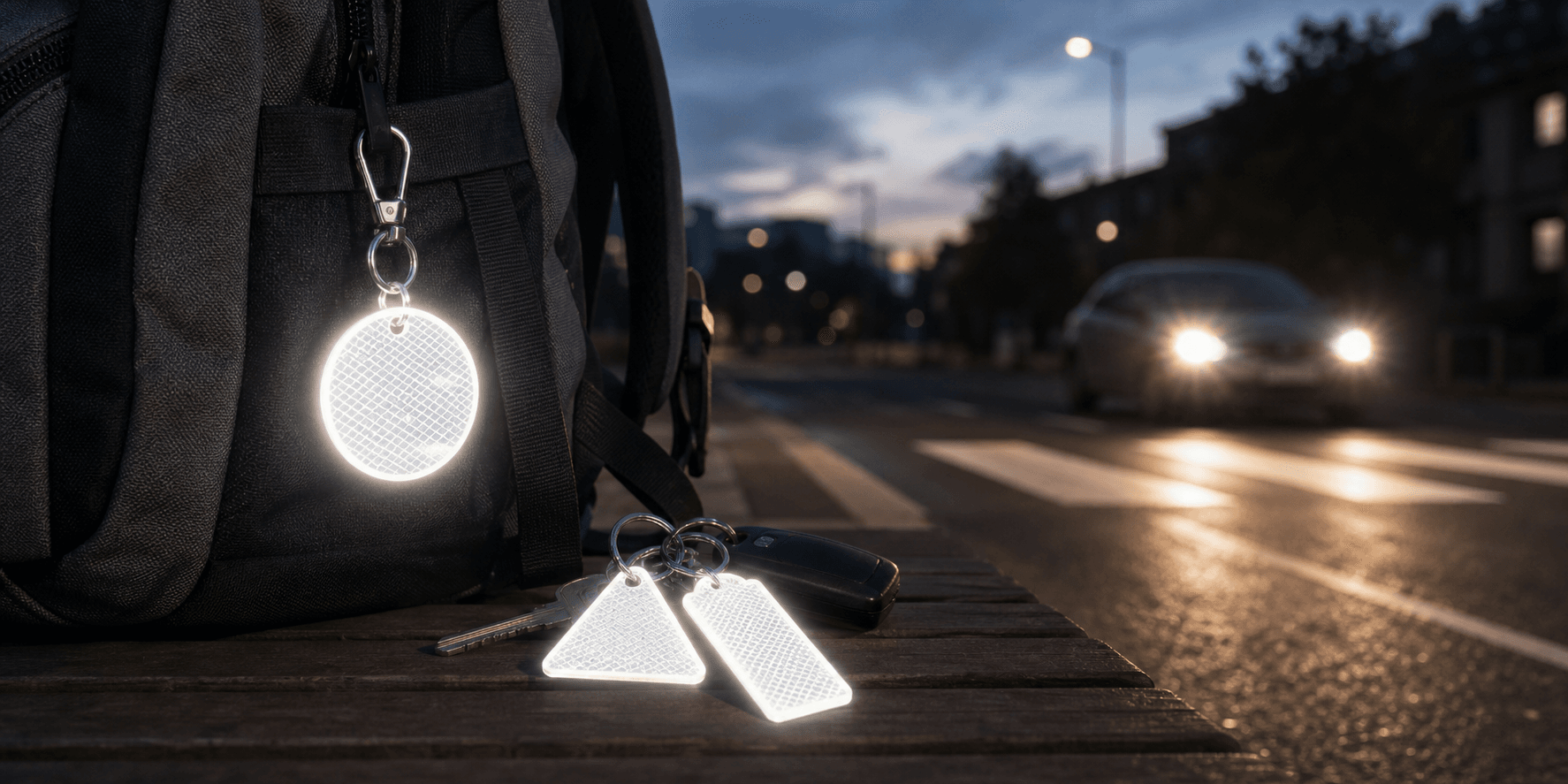
A reflector keychain is a small, portable accessory made with retro-reflective material that attaches to keys, bags, or clothing to make you more visible to drivers at night. Medway Council's road safety campaign explicitly lists a "key ring" as an example of reflective wear that "will make a difference" in helping motorists, pedestrians, cyclists, and other road users stay safe [2]. This guide explains what reflector keychains are, why they matter, how they work, how to choose one, and their limitations — based on evidence from road safety authorities.
What Is a Reflector Keychain?
A reflector keychain is a key ring or small tag that contains retro-reflective material. It is designed to be carried with your keys or attached to a bag, backpack, or clothing loop. The European Road Safety Observatory notes that "dangle tags, armbands, strips on school bags, and use of bicycle lamps" are all recommended conspicuity aids for children [1]. A reflector keychain falls into the category of a dangle tag or key-ring accessory that uses the same principle: reflecting light back toward its source.
Unlike a standard keychain, a reflector keychain is not just a decorative item. It is a safety accessory meant to increase your visibility in low-light conditions. Medway Council's "Be Bright, Be Seen" campaign includes "key ring" in its list of reflective items that can make you safer, alongside bag tags, stickers, and bike reflectors [2].
EN 17353:2020 Type B1: What Reflector Keychain Buyers Must Know
EN 17353:2020 Type B1 covers removable, free-hanging, two-sided retroreflective devices intended to improve a wearer's conspicuity in dark, medium-risk situations. A reflector keychain may fit this product concept, but it is not automatically Type B1 simply because it reflects light or hangs from a bag. Compliance applies to the identified finished device and its tested configuration [3][5].
| Type B1 design point | Requirement or buyer check |
|---|---|
| Product form | Removable, flat and free-hanging; retroreflective on both sides |
| Optically active area | At least 15 cm² on each side |
| Maximum total area | No more than 50 cm² per side |
| Thickness | No more than 10 mm |
| Attachment | At least 10 cm between the garment attachment point and the reflector attachment point, allowing rotation and a pendulum effect |
| Wearing arrangement | At least two devices, one on the left and one on the right side of the torso, for visibility from all sides |
The two-device rule is especially important. One hanging reflector does not by itself justify a "360-degree visibility" claim. The all-sides arrangement described in the user information uses at least two devices positioned on opposite sides of the torso [3].
Type B1 assessment goes beyond dimensions. Both faces are photometrically assessed in the intended hanging orientation, and the finished device is subject to applicable durability or environmental conditioning. Printing, decoration or other non-retroreflective areas do not count toward the active optical area. Buyers should therefore ask whether the test report and certificate cover the exact finished shape, construction, attachment and artwork being supplied—not merely the raw reflective material [3].
Type B1 is not a substitute for EN ISO 20471 high-visibility clothing, and it does not cover every reflective keychain, sticker, LED accessory or bulky padded charm. Product selection must follow the intended use and risk assessment. Edition note, updated August 2026: EN 17353:2020+A1:2025 is the revised harmonised reference, while the EN 17353:2020 reference remains in a transition scheduled to end on 16 December 2027 [4].
Why This Topic Matters
The risk of being unseen at night is real. The European Road Safety Observatory reports that a Dutch survey found 37% of cyclists did not have their lights on during darkness, and a Scandinavian survey found 35% did not have correct lighting [1]. Pedestrians face similar visibility challenges. Reflector keychains are simple, low-cost tools that address this problem by making you more conspicuous.
Medway Council states that with reflective wear, "at night you become visible at up to 150 metres sooner when a car headlight shines on you, giving drivers up to 5 times more distance to notice you" [2]. That additional distance can be the difference between a driver having time to react and not.
Campaigns like "Be Bright, Be Seen" exist precisely because small reflective items — including key rings — can have a meaningful impact on road safety. As the EU Road Safety Observatory explains, "both child pedestrians and cyclists benefit from conspicuity aids and the use of light-coloured and retro-reflective clothing" [1]. A reflector keychain is an easy way to incorporate retro-reflective material into your daily routine.
How It Works
Retro-reflective materials are designed to bounce light back in the direction it came from. When a car's headlight beam hits a reflector keychain, the light is reflected back toward the driver, making the keychain appear bright and noticeable. Medway Council describes this as becoming visible when "a car headlight shines on you" [2].
The key point is that retro-reflectivity works only when light strikes the material. That is why it is most effective at night or in dim conditions when drivers have their headlights on. It does not require batteries or power, and it works passively — as long as the material is clean, intact, and not covered by clothing.
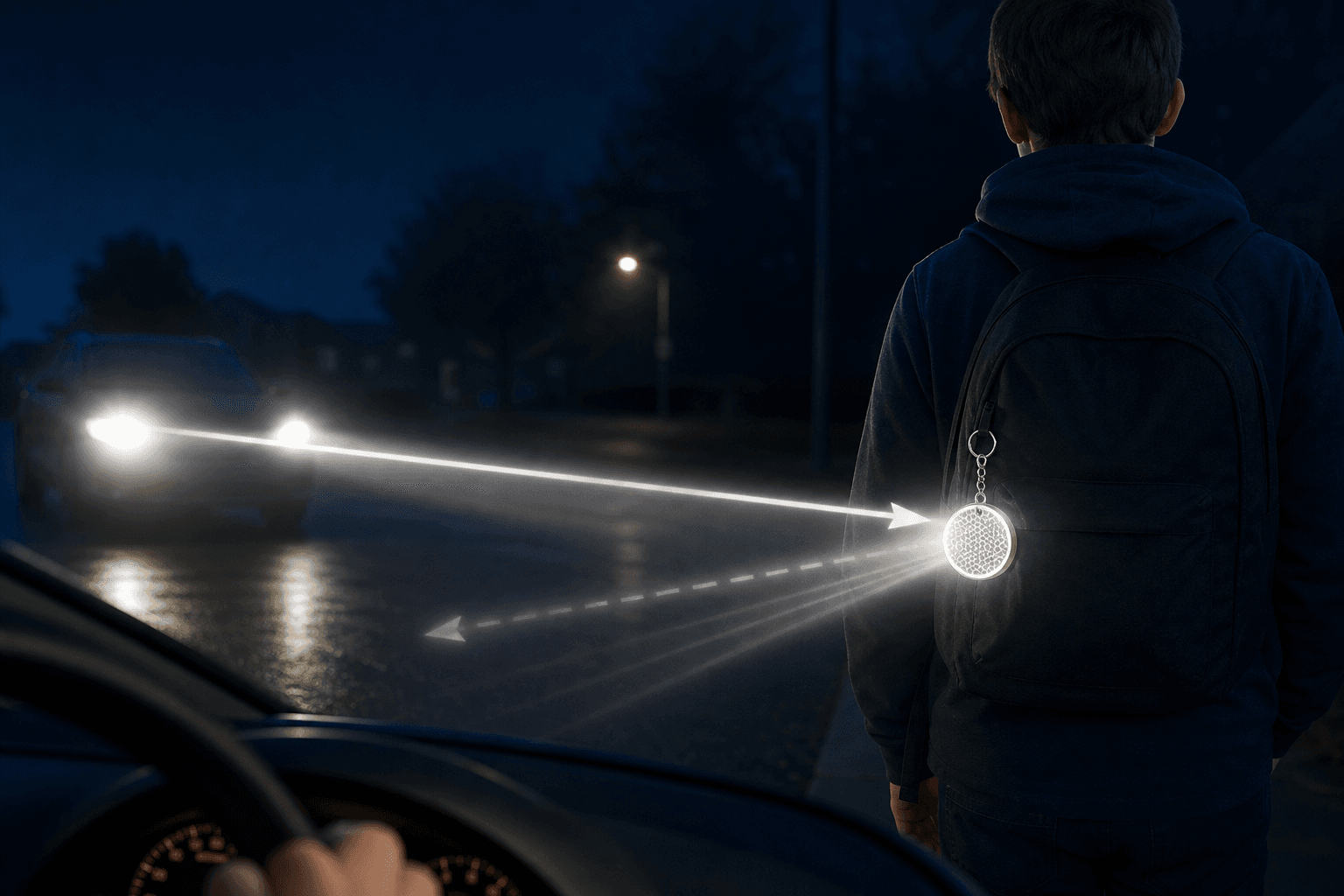
For optimal performance, attach the keychain to an outer layer of clothing, a bag, or a school backpack where it is visible to oncoming traffic. The EU Road Safety Observatory recommends using retro-reflective materials on clothing and accessories for protecting children in traffic [1]. A keychain attached to a backpack or belt loop serves a similar purpose.
Comparison and Selection Conditions
Reflector Keychains vs. Other Conspicuity Aids
Reflector keychains are just one type of conspicuity aid. The EU Road Safety Observatory lists several recommended options: dangle tags, armbands, strips on school bags, and bicycle lamps [1]. Medway Council suggests key rings, bag tags, stickers, and bike reflectors [2]. Here is how reflector keychains compare:
| Conspicuity aid | Best use | Main trade-off |
|---|---|---|
| Reflector keychain | Portable attachment for keys, bags, or clothing | Smaller reflective area than a vest or large strip |
| Dangle or bag tag | Backpack and school-bag visibility | Usually fixed to one bag |
| Armband | Moving arm visibility from several angles | Must be deliberately worn |
| Reflective bag strips | Larger, always-present coverage | Less transferable between items |
| Bicycle lamps and reflectors | Primary bicycle visibility equipment | Active lights and legally required equipment cannot be replaced by a keychain |
Selection Conditions for a Reflector Keychain
When choosing a reflector keychain, look for these characteristics, based on the evidence:
• Use retro-reflective material: The item should be described as retro-reflective, not just shiny or fluorescent. Fluorescent materials work in daytime but do not work after dark [2]. Retro-reflective materials are what make you visible in headlights [1][2].
• Attach where visible: The keychain is only useful if it can be seen. Attach it to the outside of a bag, a coat zip, or a belt loop. If it is buried in a pocket or under clothing, it cannot reflect light.
• Consider size and coverage: Smaller keychains reflect less light than larger strips. If you are in a high-risk setting, combine a keychain with other reflective items like armbands or bag strips [1].
• For children: The EU Road Safety Observatory encourages parents and safety officials to promote retro-reflective accessories for children [1]. A keychain on a school bag can be a small but practical addition, but it should not be the only safety measure.
• Keep it clean and intact: Reflective material loses effectiveness if dirty or scratched. Check it periodically and replace it if the reflective surface is damaged.
Applications, Limitations and Sources
Applications
Reflector keychains are versatile:
• Pedsestrians walking at night: A keychain on your outer bag or coat makes you more visible when crossing streets or walking along roads [2].
• Children going to school: The EU Road Safety Observatory specifically mentions encouraging parents to use retro-reflective accessories on children [1]. A keychain attached to a school bag is an easy way to add visibility.
• Cyclists as a supplement: Although cyclists must have proper lights and reflectors on their bikes [2], a reflector keychain on a backpack or jacket adds passive visibility, especially when the cyclist is off the bike or when the primary lights fail.
• Runners and walkers: Any outdoor activity in darkness benefits from retro-reflective accessories [1][2].
Limitations
Reflector keychains have important limitations:
• They only work when light hits them: If no headlight shines on the keychain, it produces no light. It does not make you visible in dark areas without traffic [2].
• Small size means small reflection: A keychain reflects less light than a full reflective vest or a large reflective strip. The EU Road Safety Observatory recommends multiple aids, such as dangle tags, armbands, and strips on school bags, not just a single small item [1].
• Not a substitute for legal equipment: Cyclists must still have required lights and rear reflectors on their bikes. Medway Council states, "it is the law to have clean and working lights on your bike - red at the back and white at the front. You must also fit your bike with red rear reflectors" [2]. A reflector keychain does not replace any legally required equipment.
• Fluorescent vs. retro-reflective: If your reflector keychain is fluorescent, it will not work after dark. Only retro-reflective material works at night [2].
• False sense of security: No reflector makes you completely safe. You should still choose well-lit routes and use the Green Cross Code when crossing roads [2].
Sources
1. European Commission, Mobility & Transport – Road Safety: "Visibility: lighting and reflecting devices" (European Road Safety Observatory, Pedestrians). https://road-safety.transport.ec.europa.eu/european-road-safety-observatory/statistics-and-analysis-archive/pedestrians/visibility-lighting-and-reflecting-devices_en
2. Medway Council: "Be Bright, Be Seen on Medway's roads" (Road safety). https://www.medway.gov.uk/info/200224/road_safety/749/be_bright_be_seen_on_medways_roads
3. BS EN 17353:2020 and BS EN 17353:2020+A1:2025 — Protective clothing, enhanced visibility equipment for medium-risk situations. https://knowledge.bsigroup.com/products/bs-en-17353-2020-a1-protective-clothing-enhanced-visibility-equipment-for-medium-risk-situations-test-methods-and-requirements
4. European Commission Implementing Decision (EU) 2026/1279 — harmonised standards for personal protective equipment. https://eur-lex.europa.eu/eli/dec_impl/2026/1279/oj/eng
5. EN17353.com: "Types & Minimum Area Requirements for EN 17353:2020." https://en17353.com/types-minimum-area-requirements-for-en-173532020/

AUTHOR
Jack Lee
Founder · Yolite Industrial Co., Ltd.
Reflective-products specialist since 2003, focused on reflective materials, high-visibility apparel, OEM customization, and practical product development for international buyers.
View LinkedIn Profile