Choosing between screen printing vs digital printing for custom safety apparel dictates whether your reflective gear survives heavy industrial laundering or fails international compliance. This guide breaks down the exact mechanical, chemical, and economic differences between traditional mesh stencils and modern micro-fluidic printheads. By understanding how each method affects EN ISO 20471 certification, setup costs, and minimum order quantities, procurement teams can avoid expensive sourcing mistakes.
Read on to discover which print application aligns perfectly with your required durability, budget, and environmental goals.
Table of Contents
ToggleUnderstanding the Core Processes: Screen vs. Digital Printing
Before diving into complex industrial wash tests and compliance standards, it is essential to establish exactly how these two technologies apply ink to high-visibility fabrics.
What Is Screen Printing on Clothing?
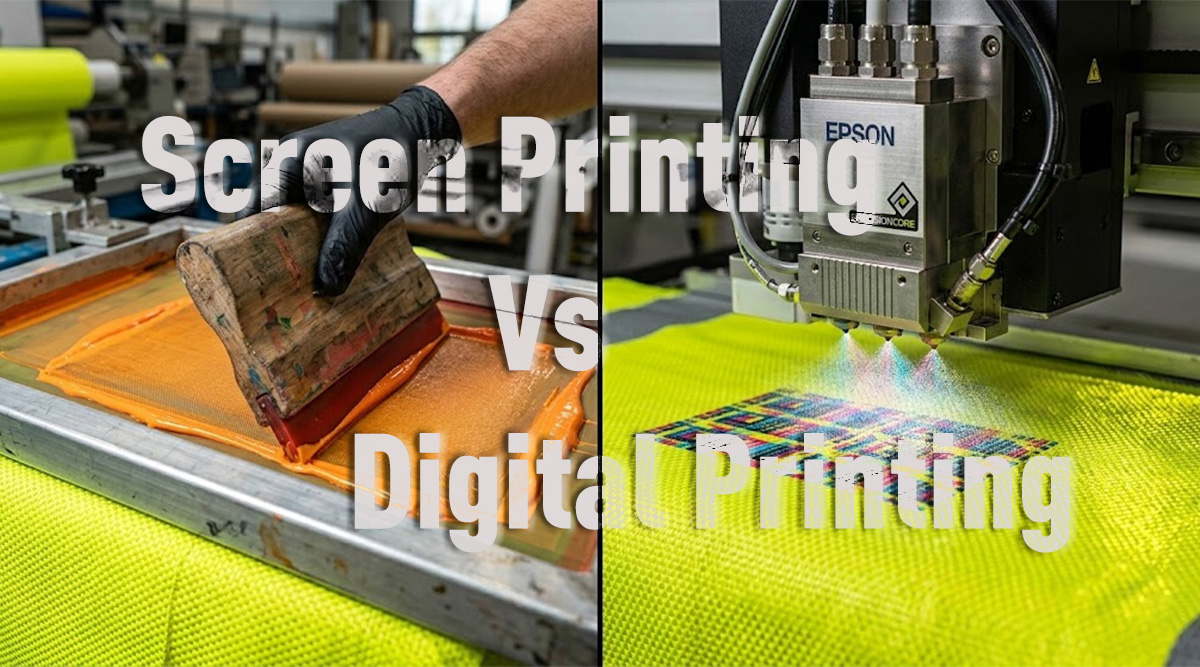
Screen printing is a traditional garment printing method where ink is physically pushed through a mesh screen onto the fabric to create a design.
In this process, each color of a design requires its own separate, custom-made screen. Thick ink is applied through the screen using a rubber squeegee, transferring the design directly onto the garment’s surface. The printed item is then heat-cured so the ink bonds permanently to the material. Because the ink layer sits heavily on top of the fabric, screen printing tends to produce bold graphics with extreme opacity.
Basic Screen Printing Workflow:
Artwork is separated into individual color channels.
A physical mesh screen is created for each specific color layer.
Ink is mechanically pushed through the screen onto the fabric.
Heat curing permanently fixes the ink to the garment.
Typical Uses of Screen Printing: Because it performs exceptionally well for medium-to-large production runs and provides highly durable results, it is commonly used for:
Company uniforms
Promotional t-shirts
Heavy-duty workwear branding
Sportswear
Hi-vis vest printing
What Is Digital Printing on Fabric?
Digital printing on fabric uses modern micro-fluidic inkjet technology to spray microscopic droplets of ink directly onto garments or textile surfaces.
Instead of creating physical screens, the design is processed entirely by software and printed in a single continuous step. Computer-controlled printheads deposit ink with absolute precision, allowing for extremely detailed, photorealistic images without the thick physical ink layer associated with screen pressing.
Typical Digital Printing Workflow:
High-resolution artwork is uploaded to the printing system.
RIP (Raster Image Processor) software processes and translates the design.
Inkjet printheads spray the image directly onto the fabric.
Heat fixation stabilizes and binds the ink.
Because the printer software blends base colors digitally, this method flawlessly reproduces complex gradients, photographic images, and multi-color corporate graphics.
Common Digital Textile Printing Types: Digital printing encompasses several distinct technologies used for complex multi-color artwork:
Direct-to-Garment (DTG)
Direct-to-Film (DTF) transfers
Dye-sublimation printing
Direct-to-fabric continuous printing
What Fabrics Work Best With Digital Printing?
Digital printing works particularly well on several specific fabric types used in the safety apparel industry.
Suitable Materials:
Polyester (The standard for high-visibility gear)
Polyester blends (Poly-cotton workwear)
Treated nylon (Requires specialized DTF or solvent inks)
Dye-sublimation printing performs especially well on 100% polyester fabrics because the dye chemically bonds with the fibers during heat transfer, leaving the fabric’s breathable pores completely open. This is why digital printing is frequently the preferred method for lightweight safety shirts, promotional garments, and athletic-style high-vis apparel.
How Does Digital Printing Work on High-Visibility Polyester Fabrics?
To understand why a print behaves the way it does under stress, it helps to examine the physical engineering behind the application. Traditional and modern methods operate on entirely different mechanical principles.
Screen printing relies on a contact-based, physical reproduction system. A specialized mesh stencil—known as a screen—must be created for every single color present in the design. A heavy, high-viscosity ink is poured onto this screen. A mechanical squeegee then applies massive downward pressure, forcing the ink through the microscopic holes in the mesh and bonding it to the surface of the reflective garment. This mechanical scraping leaves a thick, pronounced layer of pigment.
Digital printing, conversely, functions entirely without physical stencils, utilizing a non-contact micro-fluidic process. A computer translates the image data into precise electrical pulses. High-tech piezoelectric printheads respond to these pulses by spraying microscopic droplets of low-viscosity ink—measured in picoliters—directly onto the specific coordinates of the fabric. Because these droplets are microscopic, the ink penetrates the spaces between the polyester fibers rather than sitting heavily on top of them, completely eliminating the need for mesh screens.
Screen Printing vs. DTF (Direct-to-Film) for Safety Vests: Which Lasts Longer?
A frequent point of confusion arises when comparing traditional screen pressing to modern DTF (Direct-to-Film) transfers—a highly popular subset of digital printing used for safety vests. Buyers constantly ask which technology survives longer in the field.
The longevity of a print is dictated by polymer chemistry, specifically the resin content within the ink. Traditional screen printing inks are formulated with an exceptionally high resin binder content, typically ranging between 70% and 80%. When subjected to high heat during the curing process, this massive volume of resin cross-links to form a continuous, dense, and highly flexible plastic film over the fabric. This structural armor provides extreme resistance against external physical friction and aggressive laundry detergents.
DTF, while versatile, operates differently. A digital printer sprays the design onto a special PET film, applies an adhesive powder, and heat-presses it onto the safety vest. Because the digital ink itself must remain thin enough to pass through microscopic nozzles, its internal resin content is significantly lower, often hovering around 10%. While the adhesive powder helps bond the transfer to the garment, the actual color layer lacks the thick, structural polymer network of a traditional screen print.
Consequently, while DTF produces stunning, multi-colored graphics, a heavy-duty screen print will consistently outlast it under extreme wet-friction testing and repeated harsh industrial wash cycles.

Will Digital Printing Fade After Heavy Industrial Washing on Workwear?
Industrial washability is the ultimate litmus test for workwear. Safety garments worn on construction sites or in logistics hubs are subjected to grease, heavy soiling, and daily cleaning routines that would quickly destroy standard consumer apparel.
Digital printing’s greatest strength—its thin, breathable profile—can become a vulnerability in industrial wash settings. Due to the minimal resin content required to maintain fluid dynamics inside the printhead, digital pigment inks struggle to form a tough continuous phase to anchor the color particles to the fabric. Without the addition of specific chemical cross-linking agents during a strict post-treatment curing process, digitally printed logos are far more susceptible to fading, color bleeding, or staining when subjected to heavy-duty alkaline detergents and hot water.
If your workforce requires garments that endure daily, high-temperature industrial laundering, screen printing provides a significantly higher margin of safety against premature color degradation.
Does the Printing Method Affect EN ISO 20471 / EN 17353 Compliance?
Compliance with international safety standards like EN ISO 20471 (for professional high-visibility clothing) and EN 17353 (for medium-risk situations) is non-negotiable. Interestingly, the method you choose to print your company logo can directly jeopardize these certifications.
EN ISO 20471 mandates a minimum surface area of highly conspicuous background material (the fluorescent yellow or orange fabric). Traditional screen printing, with its 70% to 80% resin content, creates a completely opaque, solid barrier. If a company requests a massive, solid screen-printed logo across the back of a jacket, that printed area no longer counts toward the required fluorescent surface area. If the logo is too large, the garment will fail the certification. Furthermore, this solid plastic layer completely blocks the fabric’s capillary pores, drastically reducing breathability and wearer comfort.
Digital printing, particularly dye-sublimation on polyester, interacts differently. The dye molecules diffuse directly into the amorphous regions of the fiber structure, forming a solid solution without using resin binders. This process is entirely “coating-free,” meaning it preserves 100% of the fabric’s natural breathability and microscopic texture. However, because it alters the color of the fabric, large digital prints must still be calculated carefully to ensure the remaining fluorescent area meets strict EN standards.
Why Is Printing White Logos on Dark Reflective Garments So Expensive?
Supply chain leads are often surprised by the sudden spike in unit pricing when they request a solid white logo digitally printed onto a dark navy safety jacket or black reflective trim. The root cause lies in complex colloidal chemistry.
To accurately render bright colors on a dark substrate, a highly opaque white underbase must be applied first. In traditional screen manufacturing, this is a mature and inexpensive process utilizing thick, high-concentration white paste.
Replicating this in a digital environment is currently a massive technical hurdle. Digital white inks rely on ultra-fine titanium dioxide (TiO2) nanoparticles to achieve opacity. However, this inorganic pigment has a significantly higher density than water or organic solvents. Inside the delicate micro-fluidic tubes of a digital printer, these heavy particles constantly threaten to settle, clump, and cause irreversible blockages in the printhead nozzles.
To prevent catastrophic equipment failure, factories must utilize highly refined, expensive imported inks and run continuous circulation systems. This high reliance on premium imported consumables and increased machine maintenance is the primary reason digital white printing on dark fabrics remains an expensive bottleneck.
Can Digital Printing Accurately Reproduce Complex Multi-Color Logos on Reflective Tape?
When a brand identity demands photorealistic imagery, smooth gradients, or subtle drop shadows on safety gear, the technical limitations of traditional methods become glaringly obvious.
Screen printing is physically bottlenecked by the mesh count of the stencil. Even when utilizing specialized setups, the physical holes in the screen prevent the reproduction of ultra-fine gradients and high-frequency visual details. Additionally, every single color requires a dedicated screen setup, making a 10-color corporate logo financially impractical for most applications.
Digital printing algorithms, controlled by a Raster Image Processor (RIP), excel in this scenario. By meticulously layering varying volumes of base colors (Cyan, Magenta, Yellow, Black) in a process called dithering, digital printheads can flawlessly reproduce complex, multi-colored designs with photographic resolution. Whether printing on the soft shell of a jacket or directly onto a micro-prismatic reflective tape, the non-contact spray ensures exact color matching without incurring additional setup charges for extra colors.
How Many Colors Can Screen Printing Realistically Handle?
While screen printing can handle multiple colors, the physical limitations of the process mean that every single color requires its own dedicated mesh screen and setup sequence.
For practical, cost-effective workwear designs, the industry standard is:
1–4 colors for maximum cost efficiency.
Occasionally up to 6 colors for premium orders.
Beyond that point, setup complexity increases exponentially, and production costs rise to levels that usually do not make financial sense. If a corporate logo requires 7 colors, subtle drop shadows, or photorealistic gradients, digital printing immediately becomes the superior choice, as the software blends base colors automatically without the need for additional physical stencils.

What Is the Minimum Order Quantity (MOQ) for Screen-Printed vs. Digital-Printed Safety Jackets?
Understanding the economic models driving production Minimum Order Quantities (MOQ) allows buyers to optimize their inventory strategies. The cost curves for these two processes are fundamentally inverted.
Screen printing demands a heavy upfront investment in fixed costs (CapEx) and human labor. The process of color separation, exposing the screens, mixing the heavy pastes, and washing the stencils consumes significant time and material before a single garment is printed. To absorb these heavy sunk costs, manufacturers must impose high MOQs—frequently requiring hundreds or thousands of pieces per run.
Digital production fundamentally disrupts this function. By eliminating physical stencils and manual ink mixing, the initial setup cost drops to virtually zero. An operator simply loads the digital file and initiates the print sequence. This extreme agility enables “single-piece” minimums, perfectly aligning with modern supply chain strategies that favor low inventory, rapid prototyping, and highly fragmented batch orders.
How to Calculate the Cost Per Piece for Custom Printed High-Vis Safety Shirts?
To accurately forecast procurement budgets, buyers must look beyond the initial quote and calculate the true cost per piece over the garment’s lifecycle. A common error is evaluating the raw material “price per liter” rather than the “color-forming efficiency”.
Digital inks, due to advanced nano-milling and purification, carry a much higher price tag per kilogram than standard screen pastes. However, digital micro-fluidics dictate that ink is deposited purely on demand, pushing the pigment utilization rate close to 100%.
In contrast, traditional screen printing generates massive physical waste. During every color change or screen washing, kilograms of residual paste are flushed away as environmental waste.
When calculating the true ROI, consider these variables:
- Setup Amortization: For orders under 200 pieces, the high setup fees of screen printing drastically inflate the per-unit cost. Digital remains flat and predictable.
- Color Complexity: If the design features 5+ colors, screen printing requires multiple setups and alignments, increasing both labor costs and the risk of misregistration.
- Lifecycle Replacement: If a cheap digital print washes out after 10 cycles in an industrial laundry, the cost to replace the entire safety shirt far outweighs the initial savings. For high-abrasion environments, investing in the thicker resin layers of a screen print yields a much lower cost-per-wear over time.
The Environmental Footprint: Water Reduction and VOC Elimination
Corporate Environmental, Social, and Governance (ESG) metrics are no longer optional guidelines; they are strict prerequisites for entering global supply chains.
Traditional screen printing leaves a heavy ecological footprint. The continuous cycle of washing screens and squeegees requires massive volumes of water mixed with strong chemical solvents, generating highly toxic wastewater loaded with heavy metals and un-cured resins. Furthermore, the operational environment often involves volatile organic compounds (VOCs) that pose long-term respiratory hazards to facility workers.
Digital technology offers a profound decarbonization of the printing process. Utilizing closed-loop fluid systems and precise drop-on-demand technology, it virtually eliminates the generation of waste paste and VOC emissions. Engineering data confirms that modern industrial digital systems can slash water consumption by over 85% and reduce overall high-concentration wastewater discharge by more than 80%. For wholesale buyers mandated to source through green supply chains (such as ZDHC zero-discharge standards), digital printing provides an undeniable compliance advantage.
Comparing Print Methods for Your Procurement Strategy
To quickly evaluate which application aligns with your current safety apparel project, review the comparative matrix below.
| Project Requirement | Recommended Method | Strategic Rationale |
| High Volume (1,000+ pcs), 1-2 Solid Colors | Screen Printing | Economies of scale absorb setup costs; fastest mechanical production speed. |
| Low Volume (<100 pcs), High Color Complexity | Digital Printing | Zero physical setup fees; flawless reproduction of unlimited colors and gradients. |
| Extreme Industrial Washability | Screen Printing | 70-80% resin content forms a highly durable physical barrier against heavy friction. |
| Maintaining Maximum Fabric Breathability | Digital Printing | Micro-droplets penetrate fibers without sealing the fabric’s capillary pores. |
| Strict Zero-Discharge ESG Compliance | Digital Printing | Slashes water consumption by >85% and cuts toxic VOC emissions. |
| Specialty Textures (3D Puff, High-Build) | Screen Printing | Only physical mesh can accommodate the large particles required for textured finishes. |
Quick Decision Guide: Which Method Fits Your Project?
After reviewing the technical and financial differences, the final decision usually comes down to your production volume, artwork complexity, and durability requirements. Here is a quick summary to guide your sourcing strategy:
When Should You Choose Screen Printing?
Screen printing is often the practical choice when producing garments in larger quantities with simple graphics. Situations where screen printing is commonly selected include:
Large uniform orders
Simple logo designs (1-3 solid colors)
Industrial workwear exposed to heavy friction
Projects requiring high durability and strict wash compliance
Because the cost per unit decreases significantly as production volume increases, screen printing often becomes the preferred method for custom workwear printing and large-scale uniform programs.
When Should You Choose Digital Printing?
Digital printing is usually selected when agility, flexibility, and design detail are more important than massive production volume. Situations where digital printing works well include:
Small production runs or zero-MOQ prototyping
Multi-color graphics and gradients
Detailed, photo-based designs
Fast-turnaround project requirements
For procurement teams producing limited garment batches or safety apparel featuring complex visual elements, digital printing provides significantly greater design freedom without setup penalties.
Securing the Right Application for Your Workforce
Navigating the technical boundaries between screen printing vs digital printing ensures that your safety garments perform exactly as expected under real-world conditions. Whether a project demands the indestructible, high-volume reliability of a traditional squeegee press or the agile, multi-color precision of a digital printhead, aligning the technology with specific wash standards, fabric types, and compliance regulations is the key to a resilient procurement cycle.
As an original manufacturer specializing in reflective materials and certified safety wear, Yolite maintains complete oversight of the production and finishing process. If your team is currently developing a new line of compliant workwear and requires expert guidance on navigating these printing variables, reach out to our technical specialists to discuss your specifications, evaluate material tolerances, and request accurate physical samples.
Frequently Asked Questions
Yes, large screen-printed areas can feel stiff because the thick resin layer sits on top of the fabric. Breaking up large logos into smaller sections helps maintain garment flexibility.
While digital systems use CMYK blending to approximate thousands of colors, achieving an exact, highly saturated Pantone match (especially neons) is often more reliable with custom-mixed screen printing inks.
Bleeding usually occurs if the fabric lacks proper pre-treatment or if the garment bypasses the strict thermal curing process required to bind the low-resin digital ink to the polyester fibers.
Setup fees cover the extensive manual labor and materials required to expose, wash, and align a physical mesh stencil for every single color. Digital files bypass this entirely.
Yes, but it requires highly specialized solvent or UV inks to adhere to the smooth micro-glass beads. Standard water-based digital inks will easily wipe off reflective surfaces. Contact our engineering team to review options for printing directly on high-vis tape.