What Do These Terms Really Mean in the Reflective Safety Industry?
In the reflective safety and personal protective equipment (PPE) industry, the terms High Visibility, Hi-Vis, and Hi-Viz are often used to describe the same type of products.
However, these expressions are not interchangeable in professional communication.
Understanding the difference between these terms is important for buyers, brands, and manufacturers—especially in international trade—because terminology affects clarity, credibility, and perceived expertise.
This article explains:
-
What each term means
-
Where each term is commonly used
-
Which term should be used in professional, marketing, and compliance contexts
Definition: What Is “High Visibility”?
High Visibility is the full and formal term used to describe clothing, accessories, or equipment designed to make the wearer more noticeable in low-light, dark, or high-risk environments.
It is the most precise and universally accepted expression in the safety industry.
High Visibility is typically used in:
-
Technical specifications
-
Product manuals
-
Safety documentation
-
Compliance-related communication
-
Formal quotations and contracts
Because it is explicit and unambiguous, High Visibility is the preferred term in professional and regulatory contexts.
What Does “Hi-Vis” Mean?
Hi-Vis is an industry-standard abbreviation of High Visibility.
It is widely accepted in:
-
Product titles and categories
-
Marketing materials
-
Industry discussions
-
Website navigation and SEO content
Hi-Vis maintains a professional tone while offering a shorter, more readable format.
For this reason, it is commonly used by manufacturers, brands, and distributors in commercial communication.
Example uses:
-
Hi-Vis Safety Vest
-
Hi-Vis Reflective Accessories
What Is “Hi-Viz” or “Hi Viz”?
Hi-Viz (or hi viz) is an informal spelling variation mainly associated with British and Australasian English.
It is commonly found in:
-
Spoken language
-
UK construction sites
-
Informal workplace communication
-
Casual retail descriptions
While hi-viz is easily understood in certain regions, it is not a standardized or professional industry term.
In formal international trade—especially with European mainland markets—using hi-viz in written documentation may appear overly casual or imprecise.
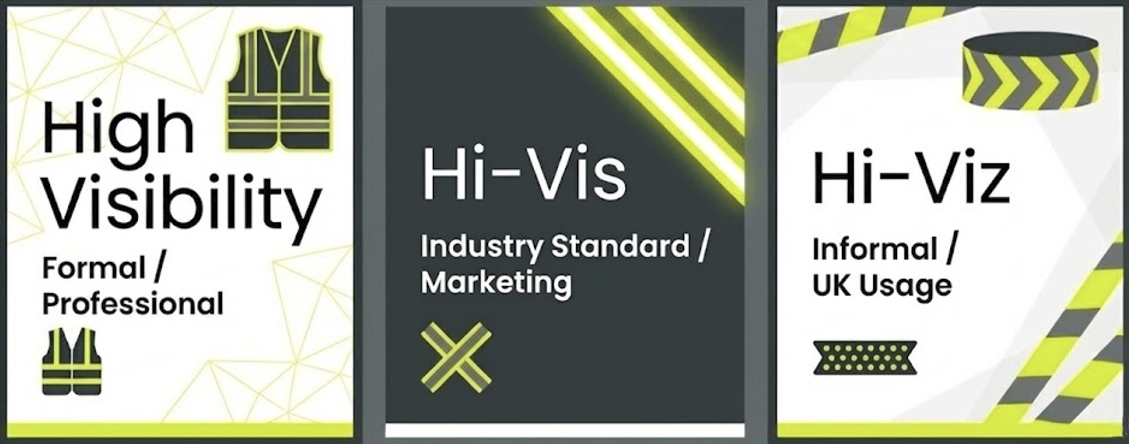
High Visibility vs Hi-Vis vs Hi-Viz: Key Differences
| Term | Formality | Typical Usage | Recommended For |
|---|---|---|---|
| High Visibility | High | Technical & professional | Specifications, contracts, compliance |
| Hi-Vis | Medium-High | Commercial & marketing | Product names, websites |
| Hi-Viz / Hi Viz | Low | Informal & regional | Casual communication (UK only) |
Which Term Should You Use?
A simple guideline is to match the term to the level of formality:
-
Use High Visibility when accuracy and professionalism are critical
-
Use Hi-Vis for marketing, product listings, and general industry communication
-
Avoid Hi-Viz in technical, legal, or compliance-related documents
Rule of thumb:
The more formal the document, the more complete the terminology should be.
Does Terminology Affect Compliance?
Terminology alone does not determine whether a product complies with safety standards.
However, consistent and professional wording signals industry competence.
In regulated markets, buyers often associate accurate terminology with:
-
Better understanding of safety requirements
-
Clearer communication
-
Higher supplier credibility
For this reason, professional manufacturers typically standardize on High Visibility or High-Visibility PPE in formal documentation.
Quick Summary
-
High Visibility is the formal and professional term
-
Hi-Vis is the accepted industry abbreviation
-
Hi-Viz is informal and region-specific
Hi-viz is how people talk.
Hi-Vis is how products are marketed.
High Visibility is how professionals communicate.
Why This Matters for Buyers and Brands
Choosing the correct terminology helps:
-
Avoid misunderstandings
-
Improve professional image
-
Build trust in international cooperation
Clear language reflects clear thinking—and in the safety industry, clarity matters.
FAQ 1: What is the difference between High Visibility and Hi-Vis?
High Visibility is the full, formal term used in professional, technical, and compliance-related contexts.
Hi-Vis is a widely accepted industry abbreviation commonly used in product names, marketing materials, and general commercial communication.
Both refer to the same type of safety products, but High Visibility is preferred in formal documentation, while Hi-Vis is suitable for marketing and everyday industry use.
FAQ 2: Is “hi-viz” a correct term in the safety industry?
Hi-viz (or hi viz) is an informal, region-specific spelling commonly used in the UK and Australasia.
While it is understood in casual conversation, it is not considered a professional or standardized industry term.
For international trade, technical specifications, or compliance-related documents, hi-viz is not recommended.
FAQ 3: Can I use Hi-Vis in technical or compliance documents?
For technical specifications, contracts, and compliance-related communication, High Visibility or High-Visibility PPE is strongly recommended.
Using Hi-Vis in these contexts is generally avoided because formal documentation requires precise and unambiguous terminology.
FAQ 4: Does using the wrong term affect product certification or compliance?
Terminology alone does not determine certification or compliance.
However, professional and consistent wording reflects industry competence and helps prevent misunderstandings with buyers, auditors, and regulatory stakeholders.
Most professional manufacturers standardize on High Visibility in formal documentation.
FAQ 5: Which term should be used on product packaging and websites?
For product packaging and websites:
-
Hi-Vis is commonly used for titles and marketing text
-
High Visibility is preferred in descriptions, specifications, and technical details
This combination balances readability, professionalism, and clarity.
FAQ 6: Why do European buyers prefer “High Visibility” over “hi-viz”?
European mainland markets—such as Germany and Scandinavia—tend to prioritize formal, standardized terminology.
Using High Visibility aligns better with professional expectations and regulatory communication, while hi-viz may appear overly casual or informal.